A Lost Generation? What the Autumn Budget Owes Young People


On Wednesday, Chancellor John Healey will present his much-anticipated inaugural budget. Among those watching, the bond investor community will perhaps be doing so with the greatest intensity. With a deficit equivalent to 5.2% of GDP last year and the last budget surplus now 25 years gone, fiscal responsibility has become the central criterion behind almost every spending or taxation decision.
However, another group, despite likely staring less intently at the announcement itself, will perhaps be equally, and certainly more personally, affected by the Chancellor's words: young people.
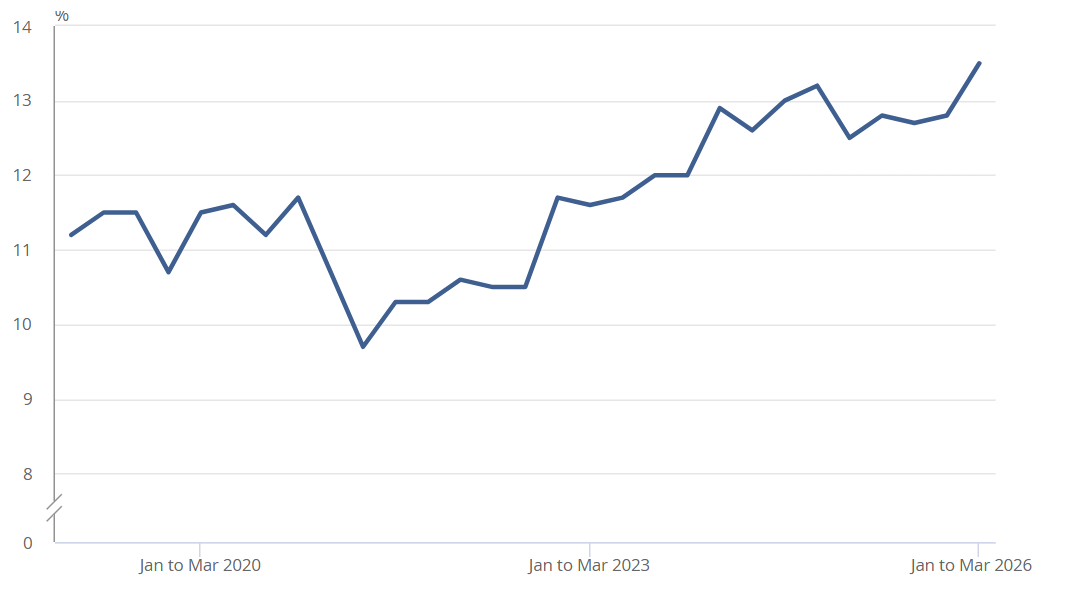
In May this year, the ONS revealed that the number of NEETs (those Not in Education, Employment or Training) had surpassed one million. That is approximately 1 in 8 people aged 16-24. The picture painted by politicians and members of the public alike in response to these figures is too often inaccurate: a lazy generation, glued to their phones and stuck in their beds. Such portrayals falsely generalise the issue as one of choice, overlooking the structural barriers to economic opportunity, mismatched political priorities, and a generation whose needs are seldom represented in policy-making.
This is a tragedy on multiple fronts. The cumulative annual cost to the government associated with this number of young people is £125 billion; greater than total public spending on education in England in 2025-2026. Reducing this number could help decrease the government deficit and ease pressure on public finances. The NEET crisis should therefore be viewed not simply as another problem for the Chancellor to "deal with" in tomorrow's Budget, but rather as a potential solution to the overarching problem in the first place.
A particularly concerning characteristic of the NEET crisis is its longevity. According to Alan Milburn's interim Young People and Work report, 70% of NEETs claiming a health and disability benefit are still claiming a decade later. This suggests that the costs extend well beyond the short term: prolonged exclusion can erode skills and productive capacity, suppress lifetime earnings and future tax revenue, and thereby potentially increase long-term public expenditure.
However, the fiscal costs tell only part of the story. The human cost to young people themselves is even more significant. As Milburn writes in his interim report, work is "not only about income...it is about connection...self-respect...independence". As one surveyed Agora Papers writer puts it, "It gives me a sense of purpose, direction and motivation...if I didn't have that I would truly plateau...spend my days watching reality TV and shopping, without doing anything of meaning". The absence of work, particularly when prolonged, risks something far more insidious than earnings: the erosion of confidence, aspirations and the sense of being able to contribute to society.
The government's survey of NEETs earlier this year found 84% of respondents wanted to be in employment, education or training, with employment cited as the most common aspiration. Indeed 69% believed that getting a job was worthwhile, while 41% identified interesting or fulfilling work as their main priority. This finding is echoed by a survey of Agora Papers writers; 100% of respondents agreed with the statement that having a job contributed to their sense of purpose, citing skills development as its main benefit, followed by greater independence and confidence. Together, these findings challenge the caricature of a generation unwilling to participate, suggesting instead that the desire to work persists even when the path towards it is obstructed.

While the issue is complex, and every young person has their own circumstances and abilities, policy too often begins by asking how to address young people's deficiencies, rather than how to develop their abilities and remove the barriers preventing them from contributing. In Britain, for every £25 the government spends on benefits, £1 is spent actually helping young people get back into work. The question too often becomes 'What can't you do?' rather than 'What can you do?'. This line of thinking bears some resemblance to Amartya Sen's capabilities approach, which evaluates prosperity in terms of the substantive freedoms and opportunities individuals have to achieve the lives they value. This is a perspective that should be more firmly embedded in policy-making. Rather than politicians being swayed by the ease of a homogeneous financial stipend, policy should move away from compensating for people's inabilities and towards helping their abilities prosper, ultimately benefiting both young people and the government in the longer term.
However, the problem cannot be solved through supply-side interventions alone. A youthful workforce equipped and willing to work is of limited use if suitable jobs do not exist or employers are unwilling to recruit. While businesses have called for reductions in labour costs to encourage youth employment, the effectiveness of such measures depends on whether lower costs translate into additional jobs. The government has already rejected calls to scrap employers' national insurance payments for all workers under 25, while Andy Burnham's pledge to lead the "most pro-business country in the world" gives business leaders reason to watch tomorrow's Budget closely. Employers have also argued that rising labour costs have contributed to job losses, with around 200,000 retail jobs reportedly lost since the increase in employers' National Insurance contributions two years ago. Lobbyists have called for limits on next year's minimum wage increases, too. Yet the government must act cautiously: there is a fine line between reducing the cost of hiring and undermining the wages and security of the very young people it seeks to support.
One aspect of the debate around the NEET crisis and youth unemployment is the apparent trade-off between supporting pensioners and investing in younger generations. This false dichotomy is reflected in the narrative that older people must "work longer to enable young people to stay in bed and not work", as one Question Time audience member put it recently. The myth of a so-called 'snowflake generation' reflects how economic policy has become increasingly framed as a generational conflict, obscuring the intergenerational contract on which the welfare state depends. An ageing population relies on a productive workforce to sustain pensions, public services and the tax base; but equally, younger people cannot be expected to sustain the economic settlement without being given meaningful opportunities to participate in it.
Yet it has become increasingly clear that the voices shaping policy do not necessarily reflect the priorities of younger generations, whose interests risk being overlooked in decisions with long-term consequences, a direct result of political short-termism. The planned axing of the UK Youth Parliament announced earlier this year, for example, further raises questions about the extent to which young people have meaningful channels through which to influence policy.

It is neither a question of one generation against another, nor a choice between fiscal responsibility and investment in young people. In many ways, this is a policy debate defined by false choices. The Chancellor faces genuine constraints, and pressure on public finances and the need to maintain fiscal responsibility mean that not every intervention can be funded. But fiscal responsibility must account for the long-term consequences of inaction as well as the immediate costs of spending. Fewer than 35% of surveyed Agora Papers writers agreed that their generation has a realistic opportunity to achieve a better standard of living than our parents' generation. And when asked what makes them feel most uncertain about their economic future, the most common response, by a four-fold margin, was the availability of jobs and career opportunities.
If the government expects this generation to sustain public services, support an ageing population and drive future growth, it must create the conditions in which they can do so. The question is not simply what Britain can afford to spend on its young people, but what it stands to lose by failing to invest in their potential.
By Dia Abdul-Rahim