A Birthright Behind a Padlock: The Fight for Little Dunn's River Beach
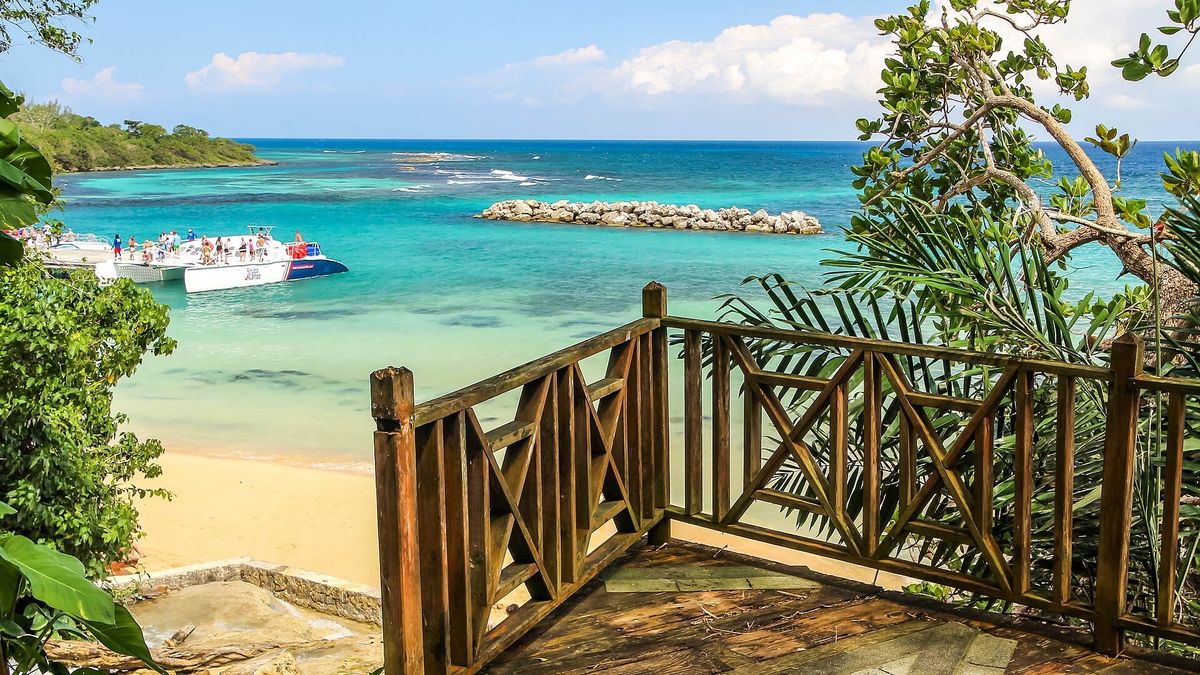
Imagine walking down a path...surrounded by the twitter of birds starting their day, hidden amongst the vegetation, ambling towards a bay where warm sands run alongside a river towards crystal-clear water. A path that has been walked by your family for generations.
Now imagine waking up one day and that path, your path, is obstructed by a forbidding gate, with a padlock and a sign attached claiming private ownership. This banishment from Little Dunn’s River Beach is exactly what confronted families from Ocho Rios and St Ann’s Bay in 2023 [i].
In response, the group JABBEM (The Jamaica Beach Birthright Environmental Movement) have made it their mission to reclaim the community’s right to the coast, arguing that “Jamaica’s physical environment forms one of the major pillars of our heritage that is worth protecting” [ii].
The argument centres around the 1956 Beach Control Act, which originally granted ownership of the “foreshore and floor of the sea” to “the Crown” [iii], until it was handed over to the Jamaican state when they gained independence in 1962. Licences have since been issued to private resorts, giving them the power to charge excessive fees for access or even outright restrict it. As a result, it is estimated that less than 1% of the Jamaican coast is freely accessible to locals [iv].
This law, which leaves the public with no inherent right to access, is blatantly clear in its favouring of private benefits over public interest. It stifles economic opportunities by barring access to fishing, which is integral to coastal communities where fisheries contribute to food security and employment. Within these communities, fishing-related activities were reported in 2017 to be the only or most important source of food and livelihood for approximately 40,000 people [v]. When locals are cut off from the sea, they are forced to become increasingly dependent on foreign imports, whilst simultaneously their livelihoods and incomes are placed in jeopardy.
As well as the economic benefits of coastal access, local communities are also being deprived of social opportunities and health benefits. Studies have linked regular time by the coast to psychological benefits, including stress relief [vi] and improvements in mood and concentration [vii]. Physical health benefits include reduced blood pressure [viii].
Socially, bathing sites can strengthen communities as they are a place to meet and interact. Beaches often become a space for families to bond by engaging in recreational activities such as sports which promote fun and, once again, stress relief [ix]. The beaches of Jamaica are also where spiritual practices such as meditative therapy and traditional baptisms [x] have created historical heritage and social cohesion.
The environment also suffers when beaches are handed over to tourists rather than locals. The damage is wide-ranging: diving classes and jet ski rides which contribute around 24 kg of CO₂ per tourist, round-the-clock energy consumption in hotels (Caribbean hotel rooms have more than twice the mean carbon footprint of a hotel room in London or Hawaii), coral reef damage, land pollution, water pollution – the list goes on [xi].
The carbon footprint of travel-related consumption is 25% higher than average emissions produced per dollar across all sectors globally [xii]. This causes concern for Jamaica in particular as, besides the direct impacts that tourism has on its biodiversity, the bigger picture of climate change poses a greater risk to the country as an island. Research suggests that a sea-level rise of 0.89–1.4 m alongside natural disasters such as tropical cyclones could cost the Caribbean $22 billion in damages and tourism losses by 2050 [xiii]. This is significant as it weakens the argument that the tourism sector benefits Jamaica through employment opportunities, as the burden of environmental repair could fall on the taxpayer, and tourism losses could eliminate those jobs altogether. The social cost of tourism to Jamaica is currently being exacerbated as private firms continue to build on the beaches that JABBEM says Jamaicans have a “birthright” to [xiv].
There are, of course, counterarguments to this. For instance, as tourism depends on developed infrastructure, such as airports, roads, ports and banks, the strengthening of such infrastructure can be seen as a supply-side benefit to the Jamaican economy. Another argument, and the one voiced by Minister of Environment and Climate Change Matthew Samuda [xv], is that tourism is essential due to its role in job creation. In 2022, tourism was the direct employer of 175,000 Jamaicans and responsible for the indirect employment of a further 354,000 [xvi].
However, although employment opportunities are essential for a prosperous economy, locals tend to fill smaller roles such as housekeeping, food service and maintenance. Meanwhile, despite being qualified and experienced in the hospitality industry, expatriates are often chosen over Jamaicans for senior and managerial roles [xvii], making it harder for locals to progress up the career ladder. By importing foreign labour for higher-paying roles, hotel chains are limiting the potential for locals’ salary and career progression and stifling the prosperity that the Jamaican people are being promised. To make matters worse, it has been reported that most of the lower-paid workers are under a “contract break” system, which leaves workers with periods without pay, benefits or insurance – a predatory system that managers (who are predominantly foreign workers) are not subjected to [xviii].
In the wider economy, tourism promises benefits to Jamaican businesses via access to more customers. Ideally, there would be a multiplier effect from tourists spending within the economy, buying food and services from locals. And yet, when the hotels that occupy the private beaches frequently use their own transportation companies and import food and entertainment from abroad [xix], the benefit to local communities is minimised. It has been estimated that this “leakage” amounts to 80% of the money spent by tourists leaving the Caribbean [xx]. Foreign ownership, where profits leave the island and locals fill subordinate roles, creates a social system that critics compare to a plantation economy [xxi].
Yet, there must be solutions to this system that assigns power to wealthy resorts at the expense of the Jamaican people. Regarding beach access, JABBEM’s argument focuses on the section of the law that says if the beach has been used for fishing, bathing or recreation for 20 years (along with an adjacent road or track to reach it), then the public has an absolute right to use it which landowners cannot override [xxii]. In the case of Little Dunn’s River Beach, the public has had uninterrupted access for over sixty years, until now, using it for fishing and recreation. Therefore, JABBEM and their attorneys argue that the public should have access to Little Dunn’s River Beach.
Their fight is not limited to this case, however, as JABBEM “demands the repeal and replacement of the Beach Control Act of 1956 with modern legislation that places the people's access at its centre” [xxiii].
It is worth noting that other Caribbean islands do not all maintain the same system. In Antigua, for instance, Prime Minister Gaston Browne rejected Sandals Resorts’ proposal to import luxury vehicles for transporting guests [xxiv]. This meant that locals could offer transportation services themselves, keeping revenues within the community. This decision shows that a government can host major international resorts whilst still prioritising local livelihoods. The abolition of the Beach Control Act could be a vital first step toward a future where the Jamaican people are protected under a similar system.
Such a system would increase the benefits of tourism by hosting holiday companies that work in conjunction with locally owned businesses and establish supply chain links that reward their host country [xxv]. To reduce the environmental impact of tourism, it is important to prioritise eco-tourism and implement legislation that protects Jamaica’s biodiversity, such as visitor licensing and conservation fees [xxvi], marine zoning, bans on single-use plastic and reef-toxic sun creams.
The tourism sector contributes to income generation, employment and foreign-exchange earnings; therefore, it is vital that policymakers keep the Jamaican people at the heart of the industry. JABBEM and this article argue that banning local people from the beaches that have been on their doorstep for generations and have supported their health, wellbeing and livelihood is morally and financially irresponsible.
The story of Little Dunn’s River Beach is not an isolated dispute over a sign and a gate. It is the latest chapter in a much older story, one where Jamaica’s land and sea are often claimed as though they are objects rather than a fundamental aspect of local culture. The Beach Control Act is an example of colonial control set to generate profits for the Crown at the expense of the people who occupy the island, and the fact that Jamaica still abides by its terms demonstrates the cruel legacy that colonialism has left.
This is, at its heart, a fight for justice because access to the sea that fed, healed and sustained Jamaicans’ ancestors should not be a privilege siphoned off to the highest bidder. By reclaiming their heritage, the Jamaican people would be a step closer to owning their future, rather than being treated as second-rate citizens in their own country. It is hoped, therefore, that families will once again walk down the path they’ve taken for generations towards a beach that was never anyone’s to lock away.
By Isabelle Borg
[i] https://news.jamaica-homes.com/archive/the-case-begins-little-dunns-river-goes-to-court-as-advocates-test-jamaicas-beach-access-law/
[ii] https://www.jabbem.org/our-heritage
[iii] https://www.nepa.gov.jm/sites/default/files/2019-11/Beach_Control_Act_1956.pdf
[iv] https://www.bbc.co.uk/travel/article/20260107-the-caribbean-island-where-locals-cant-access-the-beach
[v] https://www.fao.org/fishery/facp/JAM/en
[vi] https://www.sciencedirect.com/science/article/abs/pii/S1353829213000877?via%3Dihub
[vii] https://www.sciencedirect.com/science/article/abs/pii/S0272494411000612
[viii] https://www.gov.scot/publications/value-bathing-waters-influence-bathing-water-quality-literature-review/pages/4/
[ix] https://www.gov.scot/publications/value-bathing-waters-influence-bathing-water-quality-literature-review/pages/4/
[x] https://strongercaribbeantogether.org/jabbem
[xi] https://www.forbes.com/sites/daphneewingchow/2019/11/26/the-carbon-footprint-of-caribbean-tourism-undermines-its-economic-benefit/
[xii] https://www.forbes.com/sites/daphneewingchow/2019/11/26/the-carbon-footprint-of-caribbean-tourism-undermines-its-economic-benefit/
[xiii] file:///C:/Users/isabe/Downloads/TDH_reyer_2015_climatechangeimpactsinlatinamericaandthecarribeanandtheirimplicationsfordevelopment_author.pdf
[xiv] https://www.jabbem.org/our-heritage
[xv] https://www.theguardian.com/news/2026/jun/14/jamaica-beach-access-court-fight-privatisation-coast
[xvi] https://www.vision2030.gov.jm/blog/jamaicas-tourism-sector-is-resilient-september-2022/
[xvii] https://wiredja.com/index.php/op-ed/jamaica-paradise-lost-the-hidden-crisis-in-jamaicas-tourism-industry
[xviii] https://wiredja.com/index.php/op-ed/jamaica-paradise-lost-the-hidden-crisis-in-jamaicas-tourism-industry
[xix] https://wiredja.com/index.php/op-ed/jamaica-paradise-lost-the-hidden-crisis-in-jamaicas-tourism-industry
[xx] https://www.untourism.int/news/un-report-underscores-importance-of-tourism-for-economic-recovery-in-2022
[xxi] https://www.theguardian.com/news/2026/jun/14/jamaica-beach-access-crisis-plantation-tourism
[xxii] https://jm.vlex.com/vid/beach-control-authority-v-792922485
[xxiii] https://www.jabbem.org/little-dunn-s-river
[xxiv] https://www.stvincenttimes.com/antigua-denies-sandals-import-vehicles-guests/
[xxv] https://past.jamaica-gleaner.com/article/letters/20220430/different-approach-tourism-needed
[xxvi] https://www.seasidesustainability.org/post/how-ecotourism-legislation-can-help-protect-the-environment-recommendations-and-best-practices