What does Ferrari's $40 million fully electric vehicle say about the rest of the EV market?
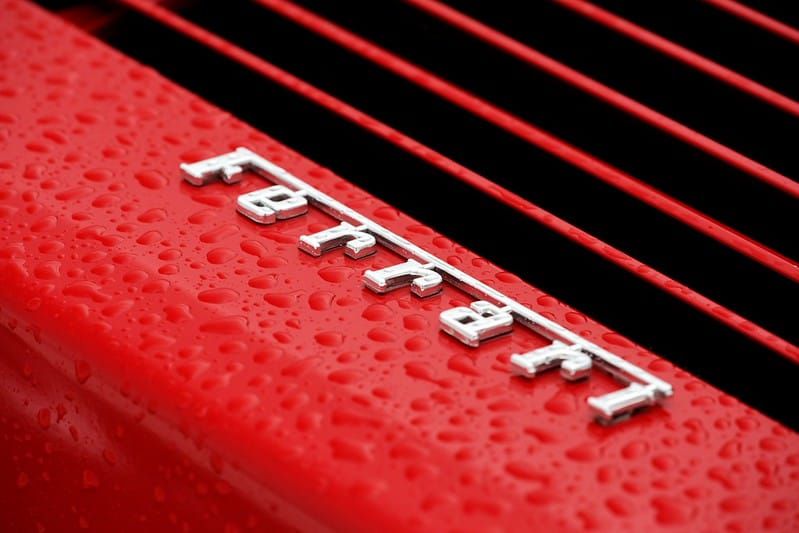
After nearly eight decades of dominating the racing scene and luxury car industry, Ferrari has finally made their first fully electric vehicle. The very first “tailor made” Luce was sold at a charity auction for a staggering $40 million, breaking records in the market of auctioned new cars, despite its controversial design which some car enthusiasts argue is distinctly different from the company’s traditional style, due to the five-seat layout and smooth surfaces - which are less aggressive looking than typical Ferraris [i]. This unique, first production EV, or “Chassis 0” has customised wheels fitted with bespoke brake calipers as well as a one-of-a-kind paint mix backing a Ferrari badge with an optical-white background.
This entrance of such a big player into the EV market is a significant move at this time, given the wider uncertainty felt by other manufacturers. This year has seen fleets primarily drive sales, as demand for new EVs has, perhaps albeit temporarily, fallen [ii]. Consequently, several brands such as Ford and Honda have scaled back production of their electric vehicles.
At the luxury end of the market, Lamborghini has redirected their plans away from making all-electric vehicles and towards making plug-in hybrids which the company’s chief executive says, still have “the emotion and power output of an internal combustion engine,” as car lovers are said to miss the “emotional connection” with the noise of an ICE [iii]. This, however, is where Ferrari’s Luce shows real potential to be successful, without succumbing to sluggish demand. They have been able to hit their sales target [iv], perhaps in part because Ferrari’s vehicle has auditory engagement, which uses a Torque Shift Engagement system, that aims to gradually deliver torque to make the driving experience of the car feel similar to other Ferraris [v], even if the exterior is less reminiscent of the brand’s other products. When we consider that amongst the top selling luxury EVs are the Porsche Taycan, BMW i4 and i7, and the Audi e-tron GT, all of which generate sounds to enhance driving experience, it becomes difficult to ignore the demand for electric cars that mimic the performance and feel of petrol and diesel cars.
However, this only really applies to the top end of the market, meaning that although Ferrari might experience success within the EV market, manufacturers targeting lower and middle-income households, still face challenges. With governments implementing emissions targets, the pressure is on to make electric cars available to the masses. Yet, the barriers to purchasing are often outside of the manufacturer’s control. The cost of purchasing and maintaining an EV can be unaffordable to many, with only 48% of households earning under £40,000 even considering purchasing one [vi].
One problem with electric vehicles is that, needless to say, you have to charge them. For many lower income households, their home is without a driveway, meaning that they would need to charge their vehicle at a nearby charging point, which is not only inconvenient but can cost up to 10x more per mile than charging at home. Even with a driveway, charger installation typically costs between £800 and £1,200 [vii] - an upfront cost which is unfeasible for many families. Furthermore, nearly 40% of lower income households buy cars priced at £5,000 or less and yet, only 1% of used EVs fall into this budget [viii], despite depreciating sharply in their first few years on the road. These high prices are often unavoidable due to the production costs of batteries and the research and development that is needed for the vehicles.
I said that only 48% of households earning under £40,000 consider purchasing an EV. In comparison, 84% of households earning above £80,000 say that they would [ix]. This shows that although some brands have been able to use advanced technology to persuade customers and car enthusiasts to purchase their electric products, the financial burdens they carry mean that many consumers are steering away from EVs. For Ferrari, at least, the electrification of their luxury vehicles has potential. For the rest of the market, however, time will tell whether electric vehicles will soon be ubiquitous on the roads, or whether the electrification movement will stall.
By Isabelle Borg
photo: https://www.flickr.com/photos/84012662@N00/4571607241/
[i] https://www.ft.com/content/3cef717f-c231-420f-8405-0b2f9c416914?syn-25a6b1a6=1
[ii] Is demand for electric vehicles really falling? — Autotrader Insight
[iii] Lamborghini pulls plug on plans to launch all-electric supercar | Automotive industry | The Guardian
[iv] https://www.ft.com/content/11ac28b0-0c82-4d4a-bcb4-0e0dae44cf87?syn-25a6b1a6=1
[v] Ferrari’s first electric car sells for $40 million at auction, nearly 40 times its $1.1 million estimate - The Economic Times
[vi] "Wealth divide" shuts poorer households out of EV market
[vii] Home EV charger installation: costs, grants & what to expect (2026) | loveelectric
[viii] "Wealth divide" shuts poorer households out of EV market
[ix] https://plc.autotrader.co.uk/news-views/press-releases/wealth-divide-shuts-poorer-households-out-of-ev-market/