Simone Veil: The Right To Choose
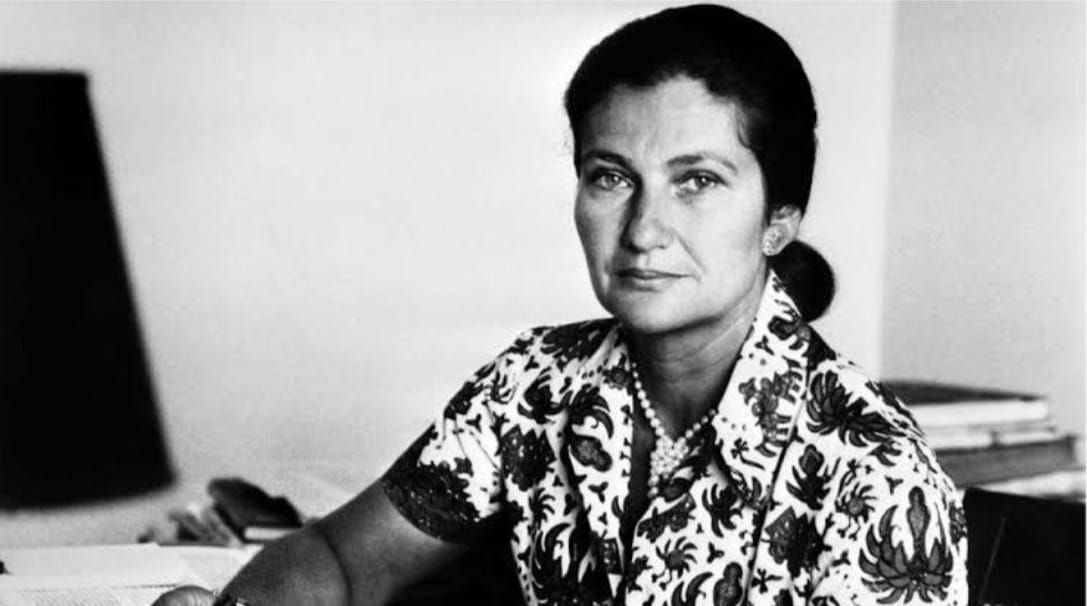
Historically, the exclusion of women from political spaces has restricted their ability to contribute to legislative decisions concerning their own bodily autonomy. However, who truly has the authority to determine this, and by what means can it be established as a legislative right? Simone Veil offered her perspective on this very question, building a legacy as an advocate for women's rights to safe conditions, contraception and abortion care throughout her career as a French magistrate and politician.
Simone Veil was born into a Jewish family in Nice in 1927, where she grew up and received her education. She completed her final high school examination in 1944, before being arrested by the Gestapo the following day, on the 30th of March. Her family was separated upon their deportation to concentration camps. Veil was taken to Auschwitz-Birkenau and subsequently to Bergen-Belsen. Following the liberation of the concentration camps at the end of the Second World War, she and her two sisters reunited in Paris in 1945, as the only survivors of their family as her parents and brother had passed away.
Veil’s experiences in the concentration camps under the Nazi regime heavily influenced her later work in raising awareness of the Holocaust and its victims. In 2001, she became the first president of the Fondation pour la mémoire de la Shoah, an organisation that funds research and educational projects on the Holocaust.
Veil later enrolled in a law programme at the University of Paris, the same year she arrived in the city, where she also met her husband, Antoine Veil. Her progression into the political sphere began after several years of practising law, when she passed the national examination to become a magistrate of the French state in 1956. Her roles within the National Penitentiary Administration and Civil Affairs enabled her to contribute to improving conditions for female prisoners, as well as adoptive and parental rights, particularly concerning dual custody for French women. These reforms marked a significant departure from the dehumanising prison conditions female prisoners had previously faced, under a repressive regime characterised by inadequate educational opportunities and vocational training.
However, Veil is perhaps best known for her role in advancing access to contraceptive care, helping to secure the passage of a law in 1974 that made contraceptives eligible for reimbursement through France’s social security system and available through family planning centres, extending the provisions of the Neuwirth law. Her position as a pioneer of women’s reproductive rights was further solidified through her fight to legalise abortion in France. Her firm political stance in defending women’s autonomy over their own bodies attracted considerable controversy and hate-motivated campaigns, targeting both her efforts to legalise abortion and her Jewish heritage. Anti-Semitic attacks were directed at her and her family through anonymous letters sent to both her home and office. Nevertheless, Veil remained firm in her position to legalise abortion and advocacy for women’s right to their bodily autonomy, culminating in the passage of the law commonly referred to as ‘Loi Veil’ in 1975.
Despite these challenges, Veil continued to progress in her political career, becoming the first female president of the directly elected European Parliament, serving between 1979 and 1982. This was a momentous milestone in her career, establishing her as a convention-defying woman and a testament to the valuable contributions that women in our society can provide in politics. However, her dedication to advocacy extended beyond women's rights. She later served as Minister of Health, Social Affairs and the City from 1993 to 1995, during which she raised awareness of disability rights and the rights of HIV-positive individuals. Such actions distinguished her from many politicians of her time, reflecting a broader commitment to protecting other marginalised groups in society.
Veil consistently emphasised the importance of independence, particularly in her career, where she sought to ensure other women had access to the same opportunities. Having seen her mother denied the opportunity to pursue a professional career, she became an advocate for policies providing maternity support, enabling women to balance motherhood with their professional ambitions. Her mother remained a role model throughout her life, even during the most challenging moments of her career. Reflecting on this influence, Veil explained that “(she) often asked what gave me the strength and will to continue the fight. I believe deeply that it was my mother; she has never stopped being present to me, next to me.”
Veil helped advance the movement for women to gain reproductive autonomy in France, while also demonstrating the importance of female representation within the institutions responsible for determining their rights. Simone Veil sadly passed away in 2017 and her remains were laid to rest in the Panthéon in 2018, making her the fifth woman to be interred there. Her legacy serves as a reminder that fundamental rights can be secured through legislative reform, but also through the courage to challenge institutions that hinder women’s right to choose.
By Amneet Kaur Sandhu
References
- AFP/Getty Images.(1974) https://www.bbc.co.uk/news/world-europe-40455507
- https://european-union.europa.eu/principles-countries-history/history-eu/eu-pioneers/simone-veil_en
- https://guides.loc.gov/feminism-french-women-history/famous/simone-veil
- https://francetoday.com/learn/icons-of-france-simone-veil/
- https://jwa.org/encyclopedia/article/veil-simone
- https://www.bbc.co.uk/news/world-europe-40455507