Responding to The Cornell 7: What Really Shapes Sexual Culture?

Warning: contains reports of sexual violence and rape that some readers may find distressing
On the 15th of October 2017, Alyssa Milano, at the recommendation of a friend and in response to Hollywood producer Harvey Weinstein’s alleged sexual assaults, posted a now infamous tweet: “If you’ve been sexually harassed or assaulted, write ‘me too’ as a reply to this tweet.” Within 24 hours, the post received over 55,000 replies and the hashtag ‘MeToo’ was trending No 1 on Twitter. This marked the beginning of a global movement; as allegations against Weinstein became public, women banded together in solidarity, united by their opposition to an exploitative and patriarchal sexual culture. The moment seemed to be a chance to break away from unfair sexual dynamics - to mould a new set of standards, where women could engage as equals.
Now, as the nine year anniversary of Milano’s tweet fast approaches, one can stand back and assess the MeToo legacy. Did the movement achieve what it set out to do? Did it really transform our sexual culture?
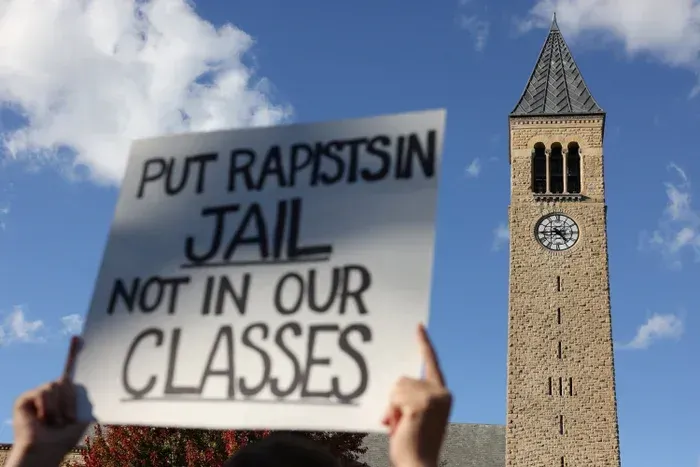
If today’s headlines are anything to go by, it would appear not. Last week, shocking allegations of a female student being gang-raped by seven fraternity brothers at Cornell University in October 2024, and the university’s scandalously lenient punishments, have dominated news cycles and social media feeds. Conversations about sexual conduct on campuses have been reawakened - an environment in which still 1 in 4 undergraduate women experience sexual violence. It is clear that what happened in Cornell is, unfortunately, not a unique event. Rather, it is emblematic of a social landscape that is increasingly frightening for women. The publication of the fraternity group chat (which included 57 members of the Chi Pi fraternity) makes for a particularly appalling read. At one point, one of the alleged assaulters refers to the victim as ‘free pussy’ - an eerie echo President Trump’s well-known brag about grabbing women ‘by the pussy’.
As Amia Srinivasan expertly diagnoses in her essay ‘Talking To My Students About Porn’, while feminist movements like MeToo have certainly succeeded in creating a ‘raised state of feminist consciousness’ - as indicated by the public outrage in response to the Cornell 7 - women are now simultaneously experiencing ‘worsening sexual conditions’ and ‘increased objectification’, continuing to be made victims of sexual violence at a staggering rate.
And so, one must ask, what is really shaping modern sexual culture?
If you are a teenager now, chances are your first sexual experience, if not one of your firsts, was through a screen. Studies indicate that a quarter of 16-21 year olds first saw pornography online while still in primary school. The average age of first exposure is 13. In 1993, Ronald Dworkin (no relation to Andrea) argued that porn viewing was simply not pervasive enough to affect the kind of widespread negative impacts that anti-porn feminists claimed it did. In an age where most people accessed porn through under-the-counter magazines or seedy movie theatres, this critique may have been somewhat plausible. In the modern age - where porn is only ever a few clicks away - it seems laughably archaic.
The digital revolution has wholly transformed pornography; it is now a ubiquitous feature of teenage life, dubbed by Sophie Gilbert as ‘the defining cultural product of our time’. In 2023, estimates put its global worth between $58 to $287 billion. Porn represents, for this generation, an authority on sex. Where sex education in schools is woefully inadequate, porn acts as a teacher.
When opening a pornographic website, the form of the website itself already affirms its defining message: women, in this imaginary and digitalised experience, are often depicted as products for consumption - sexual objects defined by their ability to facilitate (overwhelmingly) male climax. Take, for instance, the categories these videos will be sorted into: teen, MILF, gangbang, Asian, ect. If one were to put in a couple of characteristics into the search bar, those sought-after features would certainly appear on the women (rather than the men) in the videos that come up, because it is the women that are the products. This is the first act of the pornographer - to take away a woman’s personhood, reducing them to items on a sexual menu to pick and choose from. They are all, as termed by one of the Cornell 7, ‘free pussy’ - this mirrored dehumanisation demonstrating how attitudes cultivated and expressed in pornography can escape the screen and enter real-life outlooks.
Furthermore, the industry has expanded hand-in-hand with technological developments to create new types of porn, generating growth particularly in AI and OnlyFans content. OnlyFans (an adult content platform) grew exponentially after the Covid-19 pandemic, from 13.5 million users in 2019 to over 305 million in 2023. While in theory the self-publication of content by creators that is facilitated by the platform (78-84% of which are women) could hand them a degree of autonomy, this control is fundamentally never realised. Creators rely on subscribers (around 80% of which are male) paying for content. Thus, they must conform to popular sexual standards; refusing to post certain kinds of content - content that the creator, for instance, may be uncomfortable with or opposed to - can ultimately lead to a lack of engagement and, importantly, loss of income.
Therefore, although it may be the women themselves posting content, the critique of pornography as objectifying women can be sustained across platforms. Women must still market themselves within reductive and unrealistic tropes and categories to garner engagement. Many of these women utilise social media sites such as TikTok to self promote - sites primarily made up of children. This alternative model of pornography does not lead to challenging and bettering existing patriarchal sexual dynamics; it only reinforces them.
This pattern is (unsurprisingly) found again in adult content generated with the use of AI, where pre-existing pornographic tropes are recycled. Crucially, these technologies also expand the pornographer's lens from women already featured in explicit content to, through the use of deepfakes, women everywhere. Between 2019 and 2024, sexual or intimate deepfakes increased in prevalence by 1,780%. They are gaining concerning use among children; a 2024 survey by Internet Matters found that 13% of teenagers in UK schools have experienced nude deepfakes (99% of which depicted girls or women). These technologies thus provide another avenue through which sexual harassment and intimidation can occur, and buttress a sexual culture in which the right to consent and dignity for women and girls is ignored.
Finally, one also has to consider the contents. Predictably, they do not portray healthy sex acts. Almost half of all Pornhub scenes - the UK’s most popular website - include at least one act of physical aggression. The women were the targets of aggression in 97% of these scenes. (And what is the threshold for ‘physical aggression’? What other types of aggression - e.g. verbal - does this kind of statistic exclude?) By depicting the sexual subordination of and violence against women, porn arguably functions not only to legitimate, but also eroticise these acts. If this is a person’s first sexual experience, what do they expect in their own relationships? How do these digitalised representations of sex impact perceptions of it away from the screen?
It is not the aim of anti-porn feminists to suggest that the root of all sexual violence or all misogyny is pornography. Rather, it is to investigate and interrogate the role pornography can have in exacerbating sexual inequalities and normalising sexual violence. Almost half of young people say that girls expect some kind of physical aggression during sex, such as airway constriction. Research suggests that men who watch porn frequently are less likely to support affirmative action for women and to empathise with victims of rape. They are also more likely to commit sexual assault.
Nine years on from the tweet that kickstarted a global conversation about sexual culture, the Cornell 7 case has given many the wake-up-call to consider, once again, who gets to dictate sexual standards and, most importantly, who is it that benefits.
It is the aim of this article to shed light on the role pornography, in all its developing forms, has and hopefully encourage you to think critically about the ideology that it contributes to. By understanding the structures and forces that play a role in facilitating acts of sexual violence, you can better equip yourself to tackle it - to be part of that initial aim born out of the MeToo movement: moulding a new sexual culture.
By Charlotte Fox