Explainer - What is Social Mobility, and Why Is It Important?

Imagine two children, same name, same gender, born in the same city on the exact same day. Do they have the same chance of success in life, or did one of them already win or lose the lottery of success from the day they were born?
Both these perspectives can be explained by a sociological concept called social mobility, and whether the individual, family and society has it, or not.
Social mobility is defined as the ability of individuals, families or groups to move up or down the social and economic hierarchy within a society, and can be defined in two ways: intergenerationally, and intragenerationally. [1]
Intragenerational social mobility refers to how much your social and economic position changes over your lifetime. Alternatively, Intergenerational social mobility compares your social and economic position to those of your parents, and how much it has changed. For example, if you acquire a good university degree and land a well paid professional career you may experience upwards intragenerational mobility, as your financial and social position has significantly shifted. This may even result in you transitioning into a different social class to that of your parents, meaning you have also experienced upward intergenerational social mobility.
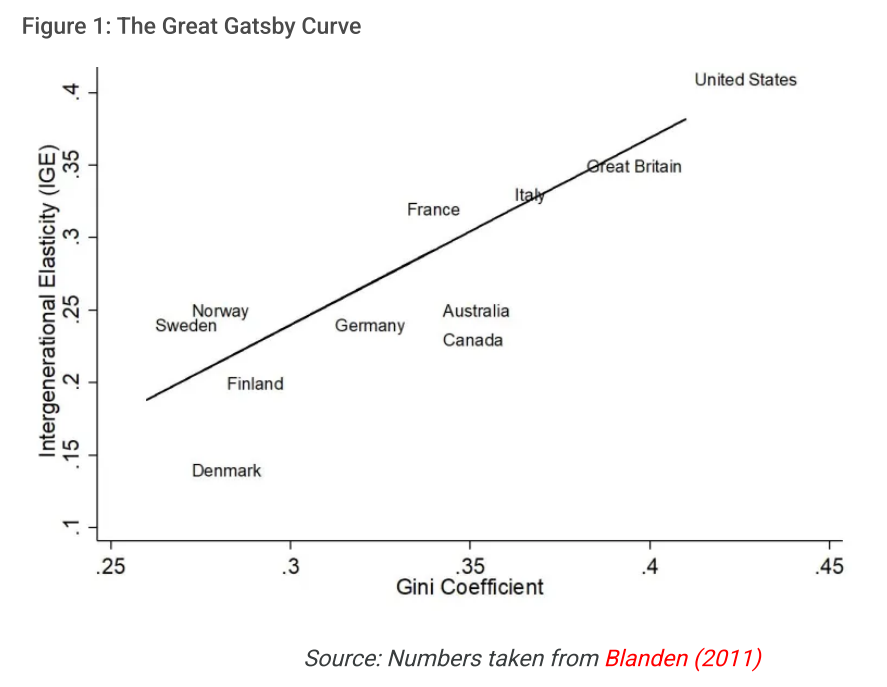
Sociologists and economists measure social mobility through tools such as Intergenerational income elasticity (IGE). This tracks how closely a child’s economic status when they grow up matches that of their parents, and can therefore be used to assess intergenerational social mobility [2]. This can be applied to a nationwide scale using a model called the “Great Gatsby Curve”. This plots intergenerational social mobility (quantified through IGE) against income inequality, and demonstrates that countries with wider wealth gaps almost always have lower social mobility [3].
For example, the United States of America ranks towards the least mobile end of the curve, displaying low levels of social mobility and high income inequality, with the bottom 50% owning less than 4% of the nation's wealth [4]! In the United States, roughly 50% of economic advantage or disadvantage is transmitted from parents to their children [5]. Returning to the newborn example from the start, one baby could have a 50% head start in the race to success simply because of the family they were born into. This is in stark comparison to Nordic countries where this number is under 20% [6], with these countries ranking very high for social mobility and low for income inequality, meaning children from poorer backgrounds have a much easier time climbing the social and economic ladder.
This is particularly interesting considering that the United States is one of the biggest advocates of social mobility, central to its individualistic culture, despite having one of the lowest among any rich country. Social mobility is a concept taught to every child in the US, through the “American dream”, the idea that personal ambition and effort (meritocracy) matter far more than your family heritage; regardless of what background one has, we all have the potential to achieve whatever dreams we envision. And yet...the statistics for the US tell a completely different story.
In capitalist societies like this, high social mobility serves as a fundamental moral justification for economic inequality, as social mobility means with enough hard work anyone can supposedly make it to the top. Yet the moral justification collapses when 50% of an individual’s economic hardship or success appears predetermined at birth.
But apart from making a fairer society, why is social mobility actually important?
Firstly, social mobility is important from an economic perspective. Wasting fantastic talent because people are trapped in areas with low opportunity and social mobility severely hurts overall national productivity and innovation, as less people can contribute their breadth of skills to society. This stems not from their lack of effort but because of external factors- such as wealth, access to professional networks and elite education [7]. The Social Mobility Foundation, as well as the Sutton Trust recognise this, aiming to achieve in the United Kingdom, “A country where young people’s talent and potential counts more than where they come from” [8].
Secondly, social mobility is essential for social cohesion, and democracy. When citizens believe in meritocracy, that the fruits of their labour will pay off, as hard work leads to a better life, they remain invested in society, including trusting democratic and economic institutions. Yet when social mobility remains low, people perceive the system as “rigged” to protect inherited privilege of the few not the many, and cynicism can becomes widespread. Without social mobility people feel trapped into an intergenerational cycle of poverty, breeding social unrest, political polarisation and breakdown in civic trust. This can undermine democracy as people feel that, regardless of the political outcome, they will remain stuck in structural poverty. Similarly, parents may discourage children from educational participation, guided by their own experiences, that their hard work in the education system did not lead to prosperity, further worsening prospects for future intergenerational social mobility.
For example, research from The Independent Inquiry into White Working Class Educational Outcomes, explored in the Channel 4 documentary “What is holding back the white-working class in Grimsby?” investigated this. They found a lack of employment prospects in the locality, worsened by the decline in the traditional fishing industry which had, for many households, reduced their hope in the potential for social mobility, and education as a ladder to success. The inquiry found a “growing belief amongst these households that the current education system does not guarantee success” [9].
Ultimately, social mobility is far more than a vague sociological concept, or economic metric. Instead, it is the basis of a successful, cohesive country - politically, socially and economically. When social mobility stalls, and meritocracy becomes a “myth”, it worsens the country for everyone, not just those who are unable to climb the financial and social ladder, reducing prosperity and unity for all. Therefore, to ensure every child has an equal shot at success, constant investment is needed in public services such as education, employment and healthcare, to ensure equality of opportunity, so that no child’s future is predetermined at birth.
By Sophie Hartley-Wiley
Footnotes:
[1]
https://www.britannica.com/topic/social-mobility
[2]
https://www.science.org/content/article/ige-anatomy-mobility-score
[3]
https://obamawhitehouse.archives.gov/blog/2013/06/11/what-great-gatsby-curve
[4]
[5]
[6]
[7]
https://www.gov.uk/government/news/study-into-non-educational-barriers-to-top-jobs-published
[8]
https://www.socialmobility.org.uk/about
[9]