Onora O'Neill: From Academia To National Policy
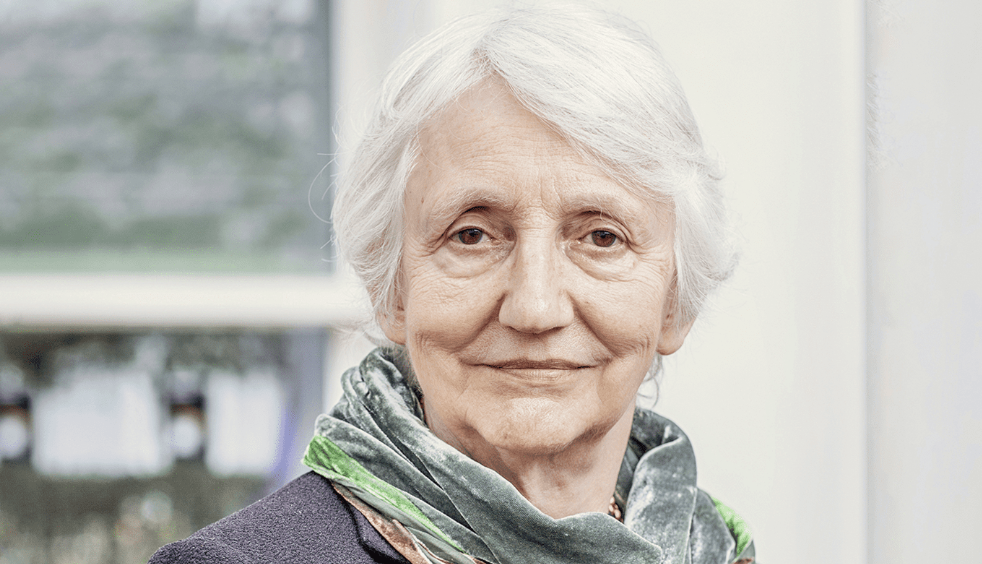
A political philosopher and crossbench peer, Baroness Onora O'Neill has contributed immensely to the debates surrounding 21st-century crises of trust between citizens and institutions. She has reinterpreted 18th-century philosopher Immanuel Kant's complex ideas about duty and intention to challenge the relationship between political institutions and public trust.
Born in 1941, in Aughafatten, Northern Ireland, Onora O'Neill studied Modern History at Somerville College, Oxford, before switching to PPP (Philosophy, Psychology and Physiology). She went on to complete a PhD at Harvard University under the guidance of John Rawls (an American political and moral philosopher) and received her doctorate in 1969. In 1977, she worked at the University of Essex, becoming a Professor of Philosophy in 1987, where she remained until 1992. Following this, she continued her professional life working as a Principal of Newnham College, Cambridge from 1992-2006. She then became the first female president of the British Academy in 2005, the UK's national academy for the humanities and social sciences.
Immanuel Kant's normative ethical theories are deontological, meaning they place a heavy emphasis on the intention behind an action and moral obligation, rather than the consequence. Morality in Kantian ethics is linked to the central concept of 'good will', the view that something can only produce moral worth if it is done out of duty. O'Neill uses this foundation to explore how ethical theories can be used as a practical guide and framework for modern ethical dilemmas. She has been commended for her transformative work in philosophy to reinterpret Kant's theories.
Across two of her published works, Faces of Hunger (1986) and Towards Justice and Virtue (1996), she challenges the way human rights are understood and implemented. She argues that a right cannot be secured unless we identify who has the duty to fulfill it - for example, a wealthy nation has the moral duty to act, rather then make a general acknowledgement that poor people have a right to food. In her 2002 BBC Reith Lectures, she stated that "The Declaration defines rights poorly, and it says almost nothing about the corresponding duties. No inspection of the Universal Declaration, or of later UN or European Documents, will show us who is required to do what for whom, or why they are required to do it."
In 1996, she became a member of the Human Genetics Advisory Commission and was made acting chair in 1999, though she departed the same year. She was the Chair of Nuffield Council on Bioethics from 1996-1998 and became chair of the Nuffield Foundation in 1998, serving for 12 years. These positions allowed her to be at the forefront of national debates regarding early genetic testing and cloning technologies, contributing to the effort that the increase in genetic exploration must be rooted in ethical boundaries. The Royal Society describes her as being 'heavily engaged in shaping science policy, especially in relation to bioethics.'
Her concept of 'principled autonomy' was used to inform debates about necessary changes regarding consent in the medical field, taken from the Kantian ideas of the Categorical Imperative (you must never treat a human being merely as a means to an end, but always as an "end in themselves"). Principled autonomy emphasises the importance of the average patient being able to provide informed consent, protecting patients from coercion and deception, and it means that they can understand what they are agreeing to instead of simply ticking a box. For O'Neill, consent is built around genuine understanding and explicit explanations. This philosophical viewpoint shows how she contributed to the wider philosophical debate about consent in medicine, and how medical institutions can respect the autonomy of patients and create a trustworthy environment.
She discussed the female experience in her 1982 essay Women and Failure. The essay explores that whilst formal rights are laid out to give women equal opportunity to men, this is not illustrated in practice. She says, "women now get ‘equal pay for equal work’, but they don’t get equal work." She continues to exemplify this by stating "They are heavily concentrated in certain ‘women’s’ lines of employment, where the going rates are relatively low, at least contrasted with work of comparable skill and responsibility done by men. Women are cleaners, canteen workers, secretaries, nurses and teachers of younger children."
O'Neill also argues that institutions shouldn't attempt to blindly increase trust and should instead focus on proving their trustworthiness. This is an important distinction for O'Neill. In a 2013 TED talk she delivered, she outlines three criteria of trustworthiness - competence, honesty and reliability. She says, 'more trust is not an intelligent aim in this life. Intelligently placed and intelligently refused trust is the proper aim. What matters in the first place is not trust, but trustworthiness.'
In 1999, she was appointed as a crossbench life peer, and assumed the title of Baroness Onora O'Neill of Bengarve. A crossbench peer is somebody who sits in the House of Lords who is not affiliated with any party - 'life' means that the title cannot be passed down to her children. She was the recipient of both the prestigious Holberg Prize and Berggruen Prize for philosophy and culture in 2017. This further illustrates her standing as an acclaimed philosopher and her influence as a policymaker, showing her as a public intellectual and not just an academic.
Through her work across bioethics, politics and public policy, Onora O'Neill has established herself as an influential figure across academia and public life. Her transformative interpretation of Kant and her application of it to trust and justice has given her international acclaim and she continues to encourage powerful institutions to display their trustworthiness through their competence, honesty and reliability in the hope to achieve a fairer world.
By Octavia Brolly