Get Out of My Pub: Llanito, the Declining Dialect of Gibraltar
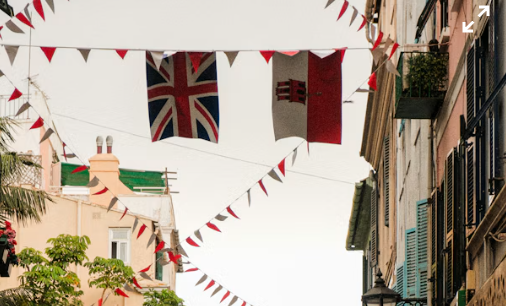
With a population of 37,936, Gibraltar has been a British Overseas Territory since 1713 when it was formally ceded to Britain 'in perpetuity' (forever). Three centuries later, Gibraltar is a vibrant Mediterranean tourist spot, popular for its Rock, its apes and its distinctive vernacular - Llanito.
Llanito is the unofficial language of Gibraltar, a dialect derived from Andalusian Spanish and British English, combined with Genoese, Maltese, Arabic and Portuguese vocabulary. It is an expression of Gibraltar's unique culture and the core of Gibraltarian identity. Llanito is the language form of what it means to be from Gibraltar. It accumulated through centuries of immigration and British integration, where English calques and idioms were naturally absorbed. A calque is a linguistic term for a word or phrase borrowed from another language by literal word-for-word or root-for-root translation.
Llanito typically uses the Spanish sentence structure whilst replacing words with their English equivalent, as can be seen in phrases like 'el parking está full' (the parking is full) or 'hay un call pa ti' (there's a call for you). These phrases would be entirely different in traditional Andalusian Spanish; the former would be translated into 'el aparcamiento está lleno'. However, for calques, English forms the structural backbone of the sentence with Spanish words slotted in. An example of this would be 'to call someone back.' In Andalusian Spanish, this would be 'volver a llamar', whereas Llanito directly translates the phrase into 'llamar para atrás'. 'Atrás' is the Spanish word for 'back', which shows how this dialect smoothly blends the two languages.
Llanito is most notably characterised by spontaneous and frequent code-switching. There is a fluidity to the language shifts and it is entirely natural - there is no pause to find an English or Spanish word, they just speak in whichever language comes to mind. This can be exemplified in the phrase 'I'm going to the tienda to buy some pan, ¿sabes?' The words 'tienda' (shop), 'pan' (bread) and the question of 'sabes' (you know) introduce the Spanish nouns into the sentence, whilst using English syntax ('I'm going to the...') to form the grammatical framework of the remark. An interesting characteristic of Llanito is this use of code-switching. English is typically used for formal concepts, for example in legal, official or school related topics, whereas Spanish is more often used in family and social settings. If you were to take a walk around the bustling streets of Gibraltar, you would most commonly hear Llanito spoken in shops, cafes, the market and on the streets.
Furthermore, Llanito has crafted its own words, generally created from the phonetic pronunciation of their English equivalent. Chewing gum is translated to 'chinga', salted peanuts are 'saltipina' and vacuum cleaner becomes 'juva' (the 'j' is pronounced like an 'h').
Yet, many linguists are of the belief that Llanito is embarking on a rapid decline. The youth of Gibraltar are now mainly educated in English, and due to the rise of social media, English is the language they are most exposed to. However, research completed by the University of Gibraltar shows how young people are maintaining their connection with the language and incorporating it into informal daily life. Gibraltar's radio station, GBC, uses Llanito for its broadcasts and in 2024, Rebecca Calderon published The Llanito Dictionaries, a compilation of two previous major dictionaries published by Manuel Cavilla and Tito Vallejo respectively. So, hope is not all lost for Llanito, whose speakers fight daily for the dialect to be remembered.
But could more be done? Gibraltarian linguists and cultural advocates argue that British intervention may be necessary to fully preserve the language. This would look like recognising Llanito as a language under the European Charter for Regional or Minority Languages and introducing Llanito and its literature into the curriculum. They could even go further so as to actively encourage simultaneous bilinguality which would keep the necessary knowledge of Spanish and English that allows Llanito to occur.
Llanito is such a unique vernacular and is only one vital aspect of Gibraltarian culture, we cannot let it die.
By Octavia Brolly