The Price of Paradise: Tourism and Everyday Life in Istria
You squint as the sun pierces your eyes. The towel you laid neatly across the rocks hours earlier has been crumpled at its edges by passing feet. Around you, the once-empty beach is alive with conversation: children splash in the shallow water, parents hand out snacks, and groups of friends queue for ice cream under the midday heat. It is easy to see why millions of visitors choose Croatia each summer.
Only three decades ago, this coastline was silent, overshadowed by the Croatian War of Independence. Today, tourism has transformed the country into one of Europe's most popular holiday destinations, directly generating 12.2% of its GDP in 2022, making it the most tourist-reliant economy in the European Union (E.U.). Yet behind the packed beaches and postcard views, many residents describe a different reality: one of rising living costs, increasing pressure on local infrastructure, and communities reshaped by the demands of a seasonal economy.
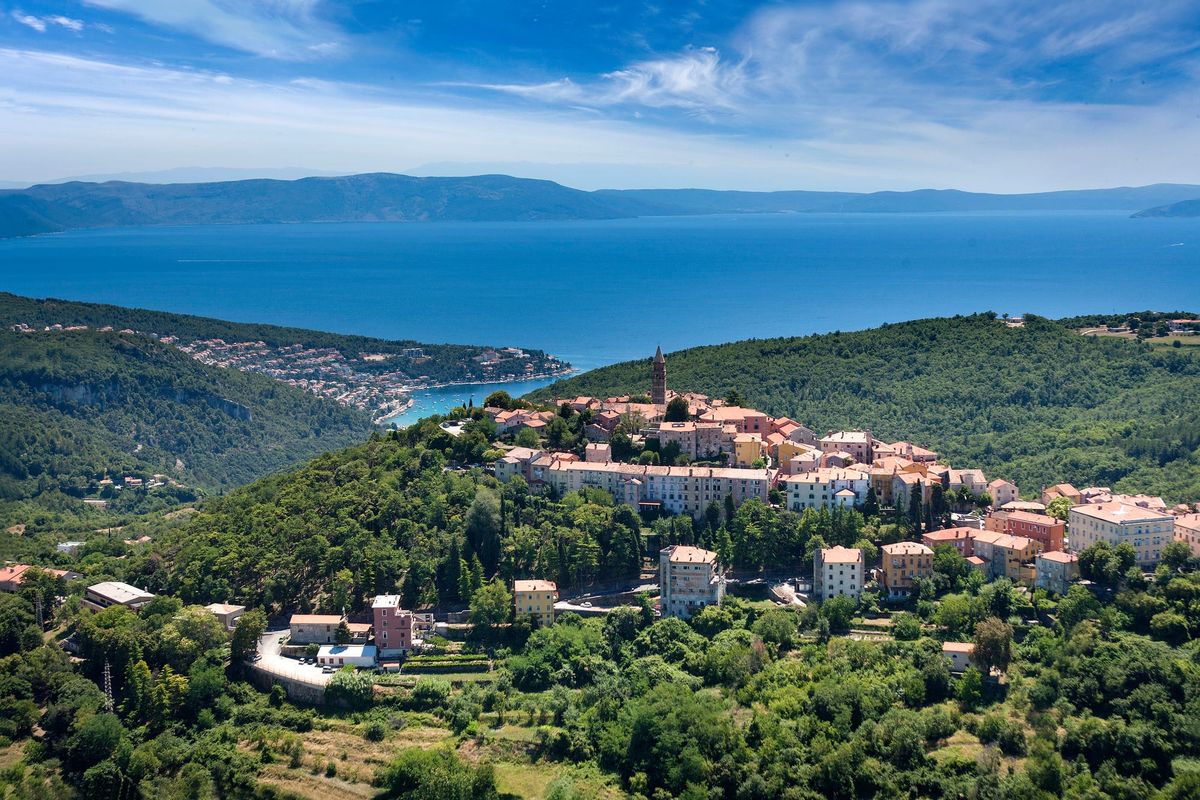
Within Croatia, the county of Istria hosted around 30% of the country’s total tourist nights. The towns of Labin, Rabac, and Sveta Marina, all lying on Istria’s east coast, received a total of 230,284 visitors in 2025, generating almost 1.2 million overnight stays. Tourism clearly leaves a substantial imprint on these communities each year. But what does it mean for those who actually live there?
To investigate whether tourism is actually improving life for the people who live here, I surveyed residents in Istria, specifically in Labin, Rabac, and Sveta Marina, conducted interviews and compared their experiences with official data, as well as generating my own price index across these three settlements and comparing it to prices in London. The findings reveal a more complicated picture than Croatia's booming visitor numbers might suggest.
Residents were approached in person across nine sites in the three towns, filtered to exclude tourists, and invited to complete the survey by QR code, giving 57 valid responses, skewed toward Labin, the largest of the three settlements.
When asked about the impacts of tourism on the economic aspects of life, including employment and business opportunities, the results were overwhelmingly positive, with 26 of the 57 individuals surveyed stating that it had an “extremely positive impact.” Of the individuals surveyed, only 17, or 29.8%, did not have an economic link to tourism. This makes the economic dependence clear: most individuals have some form of an economic link to tourism. Despite this, excluding those who were unsure, 63% reported that tourism generated no more than 24% of their income. Therefore, for most, tourism supplemented rather than replaced their primary source of income.
Yet, tourism’s economic reach does not mean that the benefits outweigh the costs for every household: 52% of respondents reported that tourism hurt the affordability of everyday goods and services. In comparison, 29% reported that it had a negative impact on the affordability of housing.1
This highlights the article’s central contradiction: how can tourism feel economically beneficial while making everyday life less affordable? To understand whether residents’ concerns were grounded in the prices themselves, I created an indexed price measure.
London is regarded as one of the most expensive places in the world; using Ocado, a high-end grocery delivery service, as a baseline, I created a price index. Ocado was deliberately chosen as a conservative comparator, since its premium pricing likely understates the true gap between London and Istrian living costs, rather than exaggerating it. On both Ocado and in Istrian supermarkets across these three settlements, I priced a small basket of essential groceries, including bread, milk, pasta, and 14 other everyday staples. I found that prices in Sveta Marina were approximately 1.8 times as expensive as on Ocado, while prices in Labin were 1.4 times as expensive. This difference may not seem huge, but the mean annual gross earnings per employed resident in London are approximately £54,7172, while in Istria, they are approximately €22,431, or £19,1673. That means that residents in Sveta Marina are estimated to pay over five times more of their income in essential groceries.
Yet, household budgets capture only the costs that can be priced. Residents also described costs paid in traffic, peace, cleanliness, and the natural environment. Of 29 interviewees, when asked what the biggest impact of tourism was, either positive or negative, 19 identified negative impacts, with 12 of these being social. From “the disruption of peace, increased stress and loss of time due to congestion on the roads, in shops and on beaches” to “too many flats and houses have been built in places that were once natural areas, only to remain empty for most of the year when they are not occupied by tourists”4, it is clear that tourism has substantially influenced quality of life across Istria. One lifelong Labin resident even noted that “farm animals are prohibited because tourists complain about the smell and disturbance,” leading to a loss of their source of income, but also their way of life, passed down through generations.
This sentiment is echoed in a July 2018 expert study written by the Institut za Turizam titled “Tourism Carrying Capacity of the Town of Labin,” which argued that “during the peak summer tourist season, overcrowding is becoming increasingly frequent - primarily on roads, in parking areas, on beaches, and within Labin’s historic old town.”
However, when asked to evaluate the impact of tourism on their quality of life, only 14% reported negative impacts, with 31% reporting no significant impact. This means that the majority evaluated its overall effect positively, while still identifying the negative social effects and impacts on affordability. This captures why the impacts of tourism are far from binary.
One private accommodation provider put this perfectly: “Because of the costs of living in a large house, tourism has a positive effect on our quality of life. However, while we are renting it out, our own comfort and privacy are reduced.”
His response shows that while tourism helps to fund home maintenance and supports his financial independence, come summertime, it reduces his control over his own space and his family’s feeling of comfort in their own home.
Back at the beach, the queues for ice cream and crowded pebbles look like signs of success. Economically, they are. Yet only 15% of residents believed tourism was reducing financial inequality. The real question, then, is not whether tourism brings money to Istria, but who captures the additional income and who absorbs higher prices, congestion, and the loss of public space without receiving the same financial return. The previously stated expert report, regarding the carrying capacity in Labin, described increasing social challenges, particularly between those directly involved in tourism and those who are not, indicating that this is building a tangible tension between locals. In an original interview, Labin Mayor Donald Blašković echoed this sentiment, stating that “those whose work or property is connected to tourism receive greater direct benefits.” Nevertheless, he argued that other residents benefit indirectly through infrastructure, investment, and the wider local economy.
While you lie on the beach or sip an Aperol Spritz, remember that your holiday in Croatia forms part of something far bigger. Tourism sustains millions, but it also imposes an automatic tax from which nobody is exempt - one paid socially, economically, and environmentally.
By Leona Bastianic
Footnotes
1. In line with widely respected questionnaire ethics, all questions were left optional. Hence, the sample sizes for these two questions were 46 and 45 respectively, while 24 and 13 individuals reported negative impacts for the respective questions.
2. Calculated by the author from Office for National statistics average gross weekly earnings of full-time employees by region. Because the average weekly gross earnings of full-time employees is reported per three-month quarters, estimated annual gross earnings of persons in paid employment in 2025 were calculated as 52 * ((1052+1061+1025+1071)/4) = 54,717.
3. Calculated by the author from Croatian Bureau of Statistics releases I-III 2025, IV-VI 2025, VII-IX 2025, and X-XII 2025. Because each release reports the average monthly gross earnings of persons in paid employment for a three-month quarter, estimated annual gross earnings of persons in paid employment in 2025 were calculated as 3 * (1817 + 1869 + 1863 + 1928) = 22,431. The GDP equivalent was calculated using the Google Currency Converter on 8 August 2026 at 18:45 (GMT+2).
4. All quotations were translated from Croatian by the author, with their original tone and meaning preserved as closely as possible.
Sources
Primary Sources
Anonymous Questionnaire given to 57 permanent residents of Labin, Rabac, and Sveta Marina, conducted in person by the author using an opportunistic sampling technique, July 2026.
Author’s original price index, compiled August 2026 based on price data from three local supermarkets in Labin, Rabac, and Sveta Marina, converted from EUR to GBP using the Google Currency Converter on 08/08/2026 at 18:35 (GMT+2).
Interview with Donald Blašković, Mayor of Labin, conducted in person by the author, August 2026.
Interviews with 29 residents of Labin, Rabac, and Sveta Marina, conducted in person by the author using an opportunistic sampling technique, July 2026.
Secondary Sources
City of Labin, Prihvatni Kapaciteti Turizma Grada Labina (2018), accessed 8 August 2026, http://old.labin.hr/Files/201808/STUDIJA%20PRIHVATNIH%20KAPACITETA%20-%20Verzija%202.pdf.
Croatian Bureau of Statistics, Average Monthly Net and Gross Earnings of Persons in Paid Employment, By Counties, First Quarter of 2025 (2025), accessed 6 August 2026, https://podaci.dzs.hr/2025/en/97058.
Croatian Bureau of Statistics, Average Monthly Net and Gross Earnings of Persons in Paid Employment, By Counties, Second Quarter of 2025 (2025), accessed 6 August 2026, https://podaci.dzs.hr/2025/en/97060.
Croatian Bureau of Statistics, Average Monthly Net and Gross Earnings of Persons in Paid Employment, By Counties, Third Quarter of 2025 (2025), accessed 6 August 2026, https://podaci.dzs.hr/2025/en/97062.
Croatian Bureau of Statistics, Average Monthly Net and Gross Earnings of Persons in Paid Employment, By Counties, Fourth Quarter of 2025 (2026), accessed 6 August 2026, https://podaci.dzs.hr/2025/en/97064.
Croatian Bureau of Statistics, Tourist Arrivals and Nights in Commercial Accommodation, 2025 (2026), accessed 5 August 2026, https://podaci.dzs.hr/2025/en/97094.
Croatian Bureau of Statistics, Tourism in Coastal Towns and Municipalities, accessed 5 August 2026, https://web.dzs.hr/PxWeb/pxweb/en/Turizam/Turizam__Turizam%20u%20primorskim%20gradovima%20i%20općinama/BS_T01.px/.
Eurostat, Tourism Statistics (2026), accessed 9 August 2026, https://ec.europa.eu/eurostat/statistics-explained/index.php?title=Tourism_statistics#Tourism_accounted_for_3.6_%_of_the_total_gross_value_added_in_the_EU_economy.
Mercer, Cost of Living, accessed 19 August 2026, https://www.mercer.com/insights/total-rewards/talent-mobility-insights/cost-of-living/.
Ocado, Homepage, accessed 8 August 2026, https://www.ocado.com/.
OECD, OECD Tourism Trends and Policies 2026: Croatia, accessed 7 August 2026, https://www.oecd.org/en/publications/oecd-tourism-trends-and-policies-2026_3fd3cd75-en/full-report/croatia_21625773.html.
Office for National Statistics, Gross weekly earnings of full-time employees by region (2026), accessed 8 August 2026, https://www.ons.gov.uk/employmentandlabourmarket/peopleinwork/earningsandworkinghours/datasets/grossweeklyearningsoffulltimeemployeesbyregionearn05.
World Travel & Tourism Council, Travel & Tourism Economic Impact Research (2026), accessed 19 August 2026, https://wttc.org/research/economic-impact.