The Algorithmic Panopticon: How Smartphone Surveillance has redefined the Gig Economy
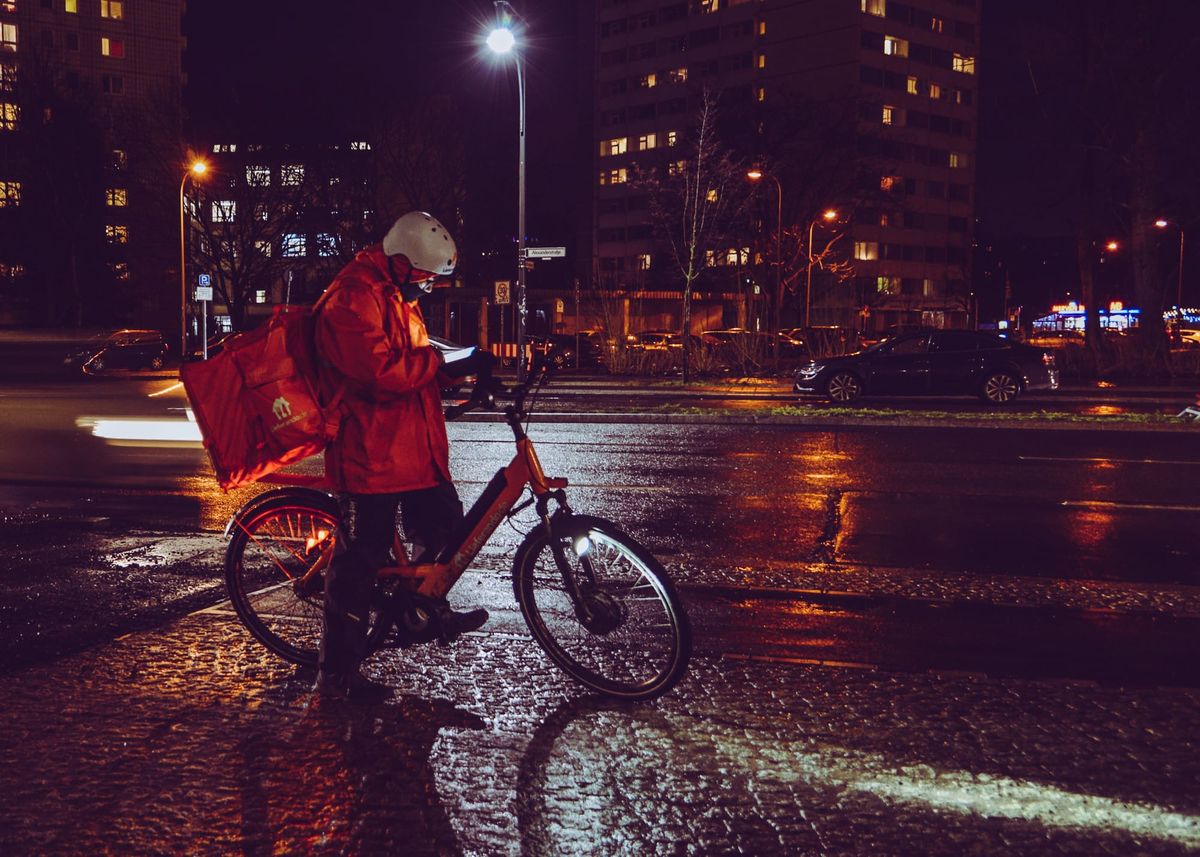
Have you ordered a Deliveroo, Uber or stayed at an Airbnb recently?
We treat these apps as parts of daily life, convenient platforms put in place where we can buy a service and see reviews instantly. However, underneath the surface lies a radical shift in how workers are being increasingly controlled by algorithms, dehumanised to a number.
A gig job is an individual, flexible short-term task that a person performs for money. For example, cleaning and taxi-driving, derived from the casualised work that musicians do, moving from place to place to find “gigs”. Now instead of walking from place to place to find work, gig workers find their jobs through online platforms to sell their labour, such as Deliveroo and Uber eats, transforming a gig job into a gig economy. The gig economy refers to a system of jobs run on a flexible basis, where you receive payment for individual jobs rather than a fixed salary.[1] For example, delivery drivers receive payment based on individual goods they deliver, and Uber drivers depending on the transportation they provide.
Whilst they provide flexibility in terms of when you want to work and how often, they provide almost no protection under Employment Act legislations, no paid holiday time off, or even minimum pay guarantees. Despite being an industry which an estimated 5 million people in the UK work in [2], many wake up in constant fear of if they have a job or not - not because they have been fired by a boss, but because an algorithm dropped their rating.
Platforms such as Uber use algorithmic management, where they immediately ask customers for reviews after journeys out of 5 stars. To most of us this seems like a normal and reasonable process, you deliver a service and receive helpful feedback. However, to gig workers one click of a button, can be the difference between economically survival and poverty. For example, the majority of the public see 4 out of 5 stars as a perfectly good service, just short of flawless - yet for Uber if a driver receives a score of less than 4.6, or sometimes as high as 4.8 out of 5 in areas such as London [3], they will be given a warning period of less than a month to improve. Otherwise, their account will be deactivated - harming their livelihood and ability to make ends meet at the click of a button, simply from one negative review, or customers merely having a different perception to the Uber algorithm of what classifies as a good rating. Despite being technically self-employed, Uber drivers remain largely at the mercy of algorithms and a stranger's split second judgement for their employment prospects
Moreover, even if your account is not deactivated, a less than perfect rating on any gig platform can demote your account to the furthest search results, making it near impossible to secure any new “gigs”, greatly reducing your job security and chance of securing reliable consistent work overnight. This job insecurity that gig workers face is illustrated by research from the University of Cambridge, which found that nearly half of all local gig workers (44%) believe they will not be able to make a living and be employed in the next 2 months, compared to around 10% for the whole workforce. [4]
This form of worker control, that the mediation between gig work and algorithmised platforms provides, not only causes economic hardship but mental strain. It dehumanises workers for their labour to simply what arbitrary number they can retain in that month, which for many can cause a loss in their sense of human dignity. Moreover, the majority of gig workers' status as independent contractors or self employed, rather than officially being an employee for the platforms means they lose traditional forms of worker representation such as Union support, further contributing to many feeling powerless and voiceless, trapped in a volatile system in a seemingly impossible quest to make ends meet.
20th century French sociologist Michel Foucault explored the Panopticon. A prison design, created by Bentham, where all inmates are surrounded by a central tower with a guard, with no way to tell if the guard is observing their actions [5]. As a result the prisoners begin to police their own behaviour, forced to conform out of pressure of being watched. Foucault argued that modern power operates through this continuous invisible surveillance, and this model expands beyond physical prisons to everyday institutions such as schools and hospitals [6]. Arguably, now the gig platforms are appearing to operate as an algorithmic panopticon, through constant GPS tracking, improvement warnings and customer star rankings, they almost exert an omnipresent gaze over gig workers, under a constant threat of automated deactivation.
For many, these pressures can lead to skipping rest breaks and working incredibly long hours, creating an "environment of overwork, marked by intense bursts of exhaustion” [7], just to satisfy the algorithms' invisible metrics.
From an anthropological perspective, ethnographic research into gig economies, most notably "Uberland" by Alex Rosenblat, exposes how these platforms disguise algorithmic surveillance as worker freedom. Her fieldwork, spanning 4 years into the lives of Uber workers, uncovers how many are introduced to the exploitative system from deceptive marketing, portraying an idyllic world where with nothing more than your own car you can become your own entrepreneur [8], enticing people into a career of automated surveillance, constant emotional labour and economic anxiety, shattering their human dignity.
Overall, the convenient apps we use on a daily basis hide a dark reality for millions of people, where technology does not liberate gig workers, transforming them into entrepreneurs in an innovative gig economy, but instead locks them into a digital prison of economic exploitation at the hands of a faceless boss: The Algorithmic Panopticon.
By Sophie Hartley-Wiley
Footnotes:
[1] https://www.weforum.org/stories/economic-growth/what-gig-economy-workers/
[2]https://www.bbc.co.uk/news/business-38930048
[3] https://fleeto.co.uk/blog/top-reasons-for-driver-account-deactivation-on-uber/
[4]https://www.cam.ac.uk/stories/gig-economy-anxiety-ratings-pay
[5]https://www.ebsco.com/research-starters/history/panopticon