Government Debt in Democracies
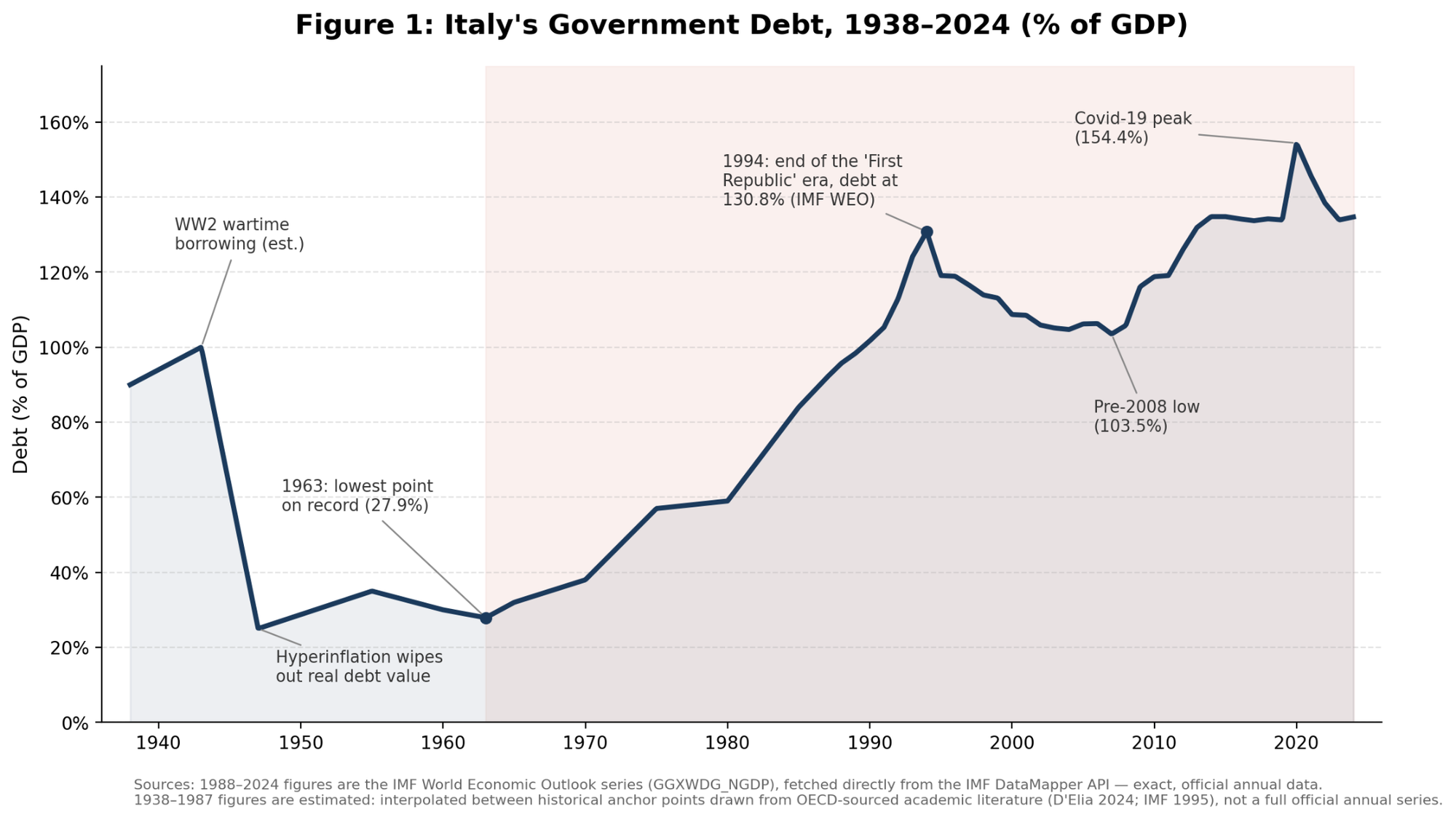
Italy has the second highest level of government debt in the Eurozone, despite being one of the bloc's largest and most advanced economies. In fact, since the mid-1960s, Italy’s level of government debt has, for the most part, been steadily rising, not just during times of financial turmoil and war but during ordinary uneventful years as well, as shown by Figure 1. This does not follow what standard economic theory predicts debt should do.
In an ideal society that is run by a social planner, a government which seeks to maximise social welfare, tax rates are kept stable. This is done as the economic cost of a tax rises faster than the tax rate itself. This is because constantly changing tax rates distort how people work, save, and invest, and as a result people operate on the basis of tax avoidance rather than economic efficiency. This distortion, known as deadweight loss, is damaging because it leads to reduced economic activity and an inefficient allocation of society’s resources. This means that hiking tax rates during a crisis and cutting them once it passes causes far more distortion than holding a moderate rate constant throughout. Hence, during times of crisis when the government requires further funds, a social planner would keep tax rates steady and instead borrow money, contributing to government debt levels. Over time, the size of this debt shrinks relative to the economy as economic growth occurs and governments run budget surpluses while tax rates remain constant. This policy, called tax smoothing, explains why government debt rises during wartime and times of financial crisis and falls during peacetime.
Yet instead of a flat line with the occasional spikes around WWII, the 2008 financial crisis and COVID-19, Italy's debt kept climbing even in the subsequent years after shocks, contradicting the expectation of debt falling as the tax smoothing theory proposes.
One proposed explanation is from economists Alberto Alesina and Guido Tabellini, and their model of strategic deficits. This model drops the assumption that the government is a social planner. Instead, Alesina and Tabellini propose that in democracies with multiple political parties, it is rational for incumbents to use government debt as a strategic tool to influence the choices of their successors. Take a government with only two political parties who differ only in the composition of public spending they prefer, such as spending on national defence or on healthcare. The party currently in power is unsure of its re-election and has the incentive to run up government debt and prioritise spending on their preferred public good (e.g. national defence). This means if faced with an election defeat, its rival party inherits this debt and is forced to make spending cuts on their preferred public good (e.g. healthcare) to pay off the debt. Hence, both parties have little incentive to prevent debt accumulation, leading to democracies often having a deficit bias.
However, this effect is dependent upon the degree of polarisation between alternating parties and the uncertainty of the government being re-elected. The more polarised the parties are, the more they wish to avoid the rival party being able to spend on their desired public good. This means that the party currently in power has a greater incentive to run up more government debt to constrain their rival’s decision, leading to more aggressive borrowing. However, if the party currently in power is confident in their re-election, then they have less incentive to increase levels of government debt as they, rather than the rival party, will bear the cost of servicing that debt.
Yet this entire model rests on the assumption that voters are non-Ricardian. Ricardian equivalence suggests that if a rational, forward-looking voter sees the government borrow today, they know that debt will eventually be paid off, either through higher taxes or cuts to government spending. This causes voters to change their behaviour, such as by saving extra to cover future tax bills, regardless of the lack of tax rises in the present. This rise in private saving cancels out the rise in government borrowing, and total spending in the economy is unchanged. A voter is non-Ricardian if they do not connect that today’s government debt leads to a future tax rise or cut to spending, so they carry on spending and saving as normal. This is what allows the government's borrowing to actually change economic outcomes and what Alesina and Tabellini’s model depends upon.
Italy is a good example of a country that fits this model. Under Italy’s First Republic (1948-1994), Italy cycled through nearly fifty governments. The disagreements regarding spending priorities led to coalitions frequently fracturing. The average government lasted under a year, meaning governing parties had the incentive to run up government debt while they were still in power. Furthermore, the electoral uncertainty meant that almost no coalition could expect to still be in power to service the debt they created. As Figure 1 shows, it was during this period of instability that Italian debt steadily climbed upwards from around 30% of GDP in the mid 1960s to 130.8% by 1994, when the First Republic collapsed. This quadrupling of government debt was not a result of one reckless government, but rather a consequence of multiple short-lived governments, each one behaving rationally given how insecure its position was.
Government debt in democracies, therefore, is not always merely a consequence of economic shocks. Rather, it can be heavily influenced by political incentives, and fragmented, insecure democracies like Italy tend to exhibit a deficit bias as a result. However, the effectiveness of debt as a strategic device rests upon the assumption of non-Ricardian voters. Other factors, such as income uncertainty, influence whether Ricardian equivalence is upheld. Households uncertain about their future income are less able to internalize the future tax liability that government borrowing implies, since they cannot confidently anticipate how or whether that burden will fall on them. There is, therefore, every reason to suggest some countries have more Ricardian voters than others. This perhaps explains why this pattern is not seen in all countries.
By Adithi Yeggoni
Contributing writer on behalf of Girls for Econ
For further reading into these economic theories:
Barro, R. J. (1979). On the determination of the public debt. Journal of Political Economy, 87(5), 940–971.
Barro, R. J. (1989). The Ricardian approach to budget deficits. Journal of Economic Perspectives, 3(2), 37–54.
Tabellini, G., & Alesina, A. (1987). A positive theory of fiscal deficits and government debt in a democracy . NBER working paper series.