A Tale of Two Cups: Who Really Wins?

The economics behind the world’s largest sporting event, and what this tells us about who the winners and losers really are.
Every four years, the World Cup casts its bright stadium lights across the globe once again. Sweepstake teams are drawn, brand-new shirts are bought, national flags reappear in windows and gardens. The sense of spirit and national identity that the beautiful game brings with it is unparalleled; creating a sort of soft nationalism, one largely free from the division, unrest and hostility so often associated with the term.
Yet in the days leading up to kick-off, a cloud of uncertainty hung over stadiums, training grounds and bracing pubs, as while the World Cup’s history has never been free from controversy - Mussolini famously hosted the 1934 tournament - this year felt different. With dynamic ticket pricing leading to record-high prices, hydration breaks becoming flashpoints over commercialisation, and fears of the tournament becoming a “MAGA showcase” (1), an uncomfortable question was raised: who really wins the World Cup? And to what extent has football’s greatest spectacle become another example of the growing commercialisation of sport and entertainment?
The answer depends on which World Cup we are talking about. The one of contracts, sponsorships, advertising deals, and political influence - a tournament contested in boardrooms and government offices long before the ball is kicked. Or the World Cup of the fans; of packed pubs, last-minute winners, shared songs and memories with strangers. In many ways, this is a tale of two Cups.
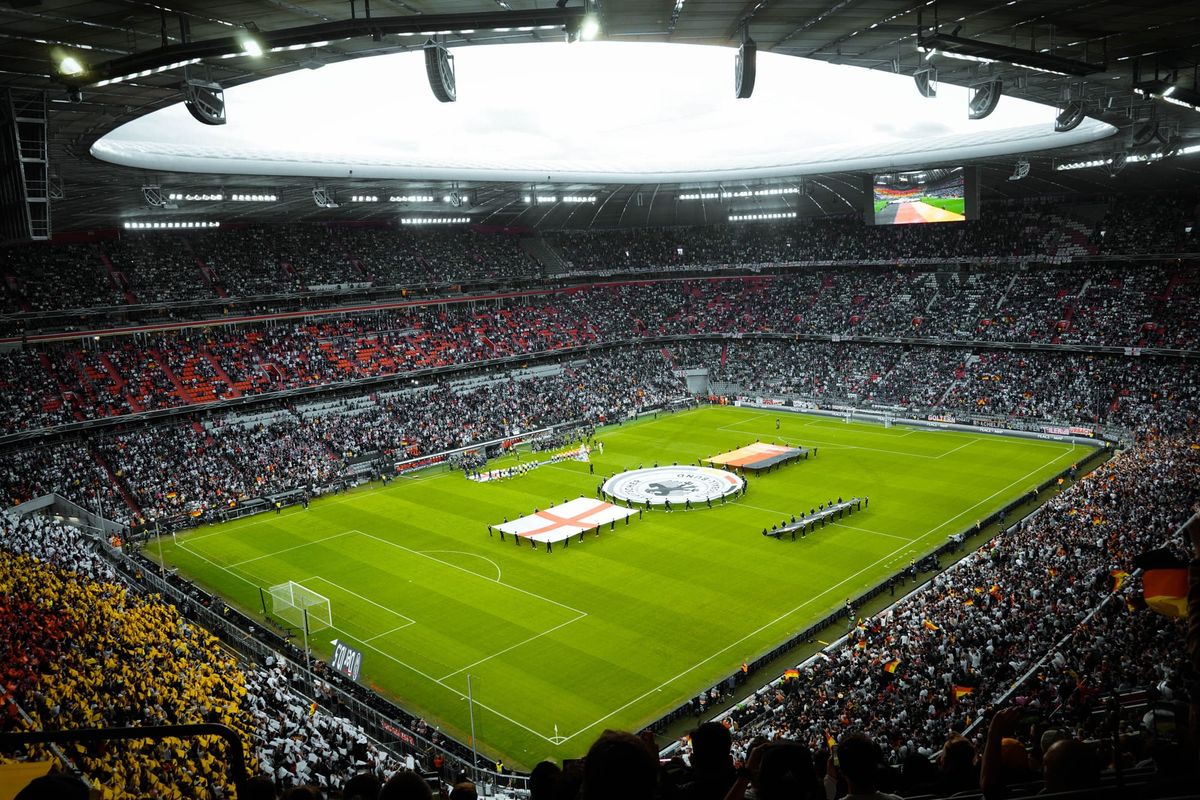
Last week, England’s dramatic victory over the mighty Aztecs will likely go down in footballing history. Playing at high altitude, surrounded mostly by Mexican supporters and faced with a red card shortly after half time, the odds seemed firmly stacked against them. So when the full-time whistle blew at 101 minutes the feeling in the hearts of England fans was one of a kind. Packed pubs at 3 AM, strangers hugging, exhausted children refusing to go to bed as they celebrated. For just over 100 minutes, football did something politics so rarely manages: it brought the nation together - at a time where division appears to have dominated British society in recent months. The expansion of the tournament to 48 teams also meant that previously excluded teams shared their part of the glory, with underdog Cape Verde holding the fierce Spaniards at bay as well as Ghana’s commendable defence against the Three Lions themselves. The celebrations of the fans of all these teams brought to light the most important aspect of this World Cup, that its success stems from the passion of ordinary supporters.
That is precisely why the tournament’s growing commercialisation matters. When fans begin to be priced out of the very spectacle they create, and when commercial and political interests increasingly shape the competition, the question becomes whether there are winners beyond the teams lifting the trophy. Perhaps there is another World Cup unfolding alongside the one on the pitch: the Cup of commercialisation.
In February 2016, Gianni Infantino became the president of FIFA, and has since been re-elected two times unopposed. However, in the decade since his appointment, concern over FIFA’s management has been growing; with many viewing what Infantino may see as structural improvement of the organisation, as no more than a transformation into a “commercial juggernaut” (2) under his leadership; putting revenue first, and the game and the fans that make it, second.
Fifa is forecasted to generate £13 billion from the tournament, a 72% increase from the previous cycle in Qatar (3). While advertising, television rights, and sponsorships are a tangible part of this, the biggest increase comes from ticket sales and hospitality, which is forecasted to more than treble. Part of this stems from the expanded nature of the competition, with 104 matches as opposed to the customary 68, but also largely due to far higher ticket prices and commission from ticket trading. However, this strategy has been met with fierce criticism, with the New York Mayor, Zohran Mamdani, leading the charge against the overpriced tournament, arranging for 1000 tickets at $50 each to be made available for ordinary New Yorkers (4), and both New York and New Jersey have subpoenaed FIFA over these sky-high prices.
Having launched its very own official ticket resale platform, FIFA charges 15% from the buyer and seller on all transactions - so with every $10,000 traded on the site, the organisation earns an additional $3000 (5). While FIFA are quick to justify this dynamic pricing strategy with a reminder of their non-profit status with all profits reinvested into global operations for the rest of the cycle, the specifics are tenuous. Although their funding has been attributed to enabling smaller nations such as Cape Verde to qualify, the efficiency of this spending is less convincing, with FIFA's approach of giving flat annual fees regardless of size to all nations, somewhat questionable; in the tiny island of Montserrat, for example, Fifa’s payments translate to about $2000 per inhabitant, while for India, it is half of one US cent per person (6).
Dynamic pricing is a long-debated strategy and by no means is this a call for its eradication; it is the same revenue management system that fills airline seats and hotel rooms, that prevents spare capacity and signals producers to supply more (7). However, the absence of a supply response to price changes due to a fixed quantity of stadium seats and the lack of competition as a result of dual ownership of primary and resale platforms means that these justifications do not apply. Jean Tirole’s use of game theory (8) to study how firms with market power should behave and how they should be regulated puts it simply: the right approach depends on the structure of the market because the same behaviour can be efficient in one and harmful in another. FIFA, unlike hotels or airlines, owns the secondary market and so arbitrage that would normally undercut becomes further revenue and profit, and the inflexible supply leaves the price free to chase demand under the assumption that loyal fans will pay higher prices (9). These specific conditions, as opposed to a blanket generalisation, provide a strong case for action from regulators.
The introduction of the infamous hydration breaks, splitting the match into the cautiously used term of “quarters" is another example of the dominance of this second cup. Despite insistence from FIFA that the breaks have been introduced to benefit player welfare in the North American heat (10), the somewhat convenient simultaneous opportunity for advertising revenue whilst disrupting match momentum has led to heavy criticism from managers and players alike, and drawn loud boos from supporters across most venues.
With a 30-second ad slot estimated to cost between $200,000 and $300,000 (and more during USA matches and final stage games)(11), the cumulative seven hours, 30 minutes and 40 seconds of hydration breaks across the tournament will certainly be lucrative for many broadcasters. Whilst fans in the UK have been protected from ads, elsewhere the match has been cut to a full commercial break or split screen format - removing fans and players from screens and instead revealing the corporate direction football is going in. While it is the broadcasters who directly gain financially, the extra income makes purchasing rights considerably more attractive to broadcasters, meaning that FIFA can theoretically charge higher prices when negotiating over future tournaments (12).
But FIFA’s controversy extends beyond their revenue-maximising behaviour and well into the political realm. The awarding of the FIFA Peace Prize to President Donald Trump last December and recent controversy over a red card reversal, revealed a core pattern around the way FIFA sometimes operates; through political flattery and strategic diplomacy, often void of moral choice and ignorant of prevalent public opinion. A recurring pattern no doubt, dating back to the second World Cup in FIFA's history, hosted by Benito Mussolini, to the 1979 Cup hosted by Argentina’s military junta, to Vladimir Putin in 2018. While Trump’s presidency is not brutal in the same way as these, the division within the United States and fractured relations with European nations, alongside the inability of fans from Haiti, Senegal, the Ivory Coast and Iran to request visas, suggests a broader pattern of FIFA's relationships as being often guided less by public sentiment and more by political and commercial expediency. Access to governments, sponsors and hosts has become as strategically important as the football itself.
As the World Cup has progressed, the magic of the game has, for many, partly drowned out the concerns that preceded it. But the problems have not disappeared; rather, they have become easier to overlook amid last-minute winners, packed pubs and unforgettable moments. As more supporters are priced out of stadiums and commercial and political interests continue to shape the tournament, we should be cautious not to normalise the changing reality of one of the few global events still able to bring people together, forget social and political divides, and get national flags out and waving - for all the right reasons.
By Dia Abdul-Rahim
References:
(1) https://www.ft.com/content/8b74a6d7-899e-41d0-8ecd-4664dd33aa9a?syn-25a6b1a6=1
(2) https://www.ft.com/content/5b79e86d-1df2-4bfa-9bde-f43eb692f11c?syn-25a6b1a6=1
(3) https://www.ft.com/content/5b79e86d-1df2-4bfa-9bde-f43eb692f11c?syn-25a6b1a6=1
(5) https://www.ft.com/content/5b79e86d-1df2-4bfa-9bde-f43eb692f11c?syn-25a6b1a6=1
(6) https://www.ft.com/content/5b79e86d-1df2-4bfa-9bde-f43eb692f11c?syn-25a6b1a6=1
(7) https://blogs.lse.ac.uk/europpblog/2026/06/30/fifa-world-cup-ticket-pricing-algorithmic-dynamic/
(8) JEAN TIROLE: MARKET POWER AND REGULATION https://www.tsefr.eu/sites/default/files/TSE/documents/doc/by/tirole/scientific_background_economics_nobel_2014.pdf
(9) https://blogs.lse.ac.uk/europpblog/2026/06/30/fifa-world-cup-ticket-pricing-algorithmic-dynamic/
(10) https://www.bbc.co.uk/sport/football/articles/cp3xqn9zxdgo
(11) https://www.bbc.co.uk/sport/football/articles/cp3xqn9zxdgo
(12)https://www.bbc.co.uk/sport/football/articles/cp3xqn9zxdgo