A Tale of Two AIs

As American hyperscalers face spiralling capex and lagging returns, comparing strategies with China exposes a fundamental divergence driving the global AI race.
The Market Tumult
Late July brought a sharp end to the months-long chip stock rally. Triggered by South Korean chip giant SK Hynix - whose shares dropped nearly 20% after earnings missed market expectations - the downturn quickly spilled across the broader semiconductor sector.
Though some selling was taking place ahead of market restrictions coming into effect on the KOSPI on Friday, the rout quickly spread to the US, with the Nasdaq briefly entering correction territory.
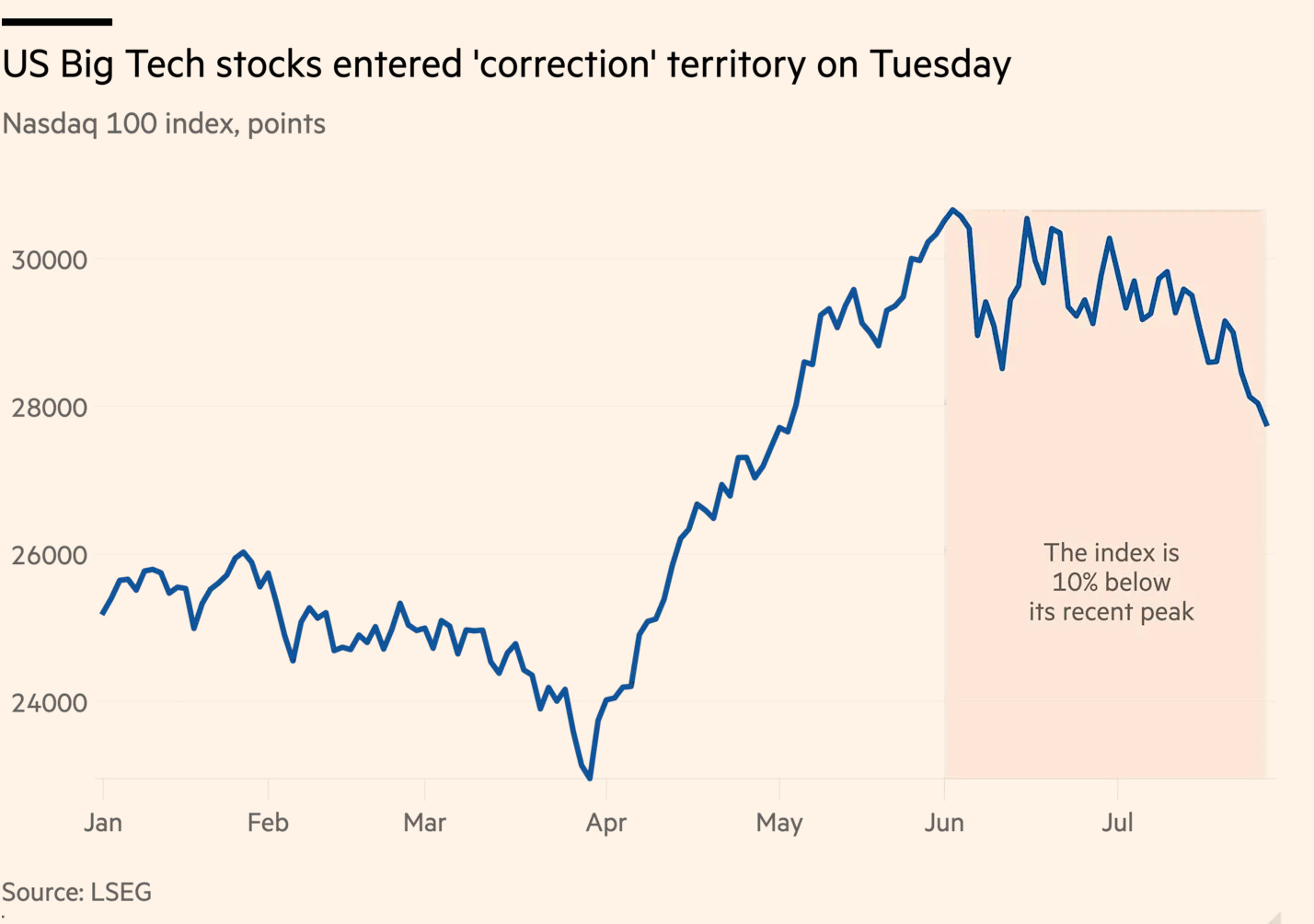
Source: Financial Times
This upheaval was something to be expected given the cyclical nature of the semiconductor industry, a topic explored in my piece AI is here to stay, exceptional returns may not be:
- Structural Anchors (Big Tech): They are at the forefront of the technology’s development, and so will remain at the centre through its evolution. The positioning of these companies aligns more with sustained, long-term growth, even if expenditure concerns lead to fluctuations.
- Cyclical Players (AI-Adjacent Firms): These firms stand to profit or lose based on developments led by the structural component. Chip stocks surged on the infrastructure build-out, while software stocks plunged on Anthropic’s coding advancements.
The recent volatility in chip stocks evidences this dynamic. Pressure on chipmakers is mounting as soaring memory costs risk curbing demand as consumers are forced to cut usage or seek cheaper alternatives. Fears of potential chip shortages have sparked massive investment plans to expand capacity, paradoxically fuelling worries of future oversupply.
Yet, while chips may have triggered the initial downturn, the broader sell-off in global tech stocks ultimately stems from a single underlying concern: the long-term sustainability of the AI boom.
Hyperscaler Revenue vs Spending
The four major hyperscalers have poured more than $1tn into capital expenditures since the race to dominate AI began three and a half years ago.
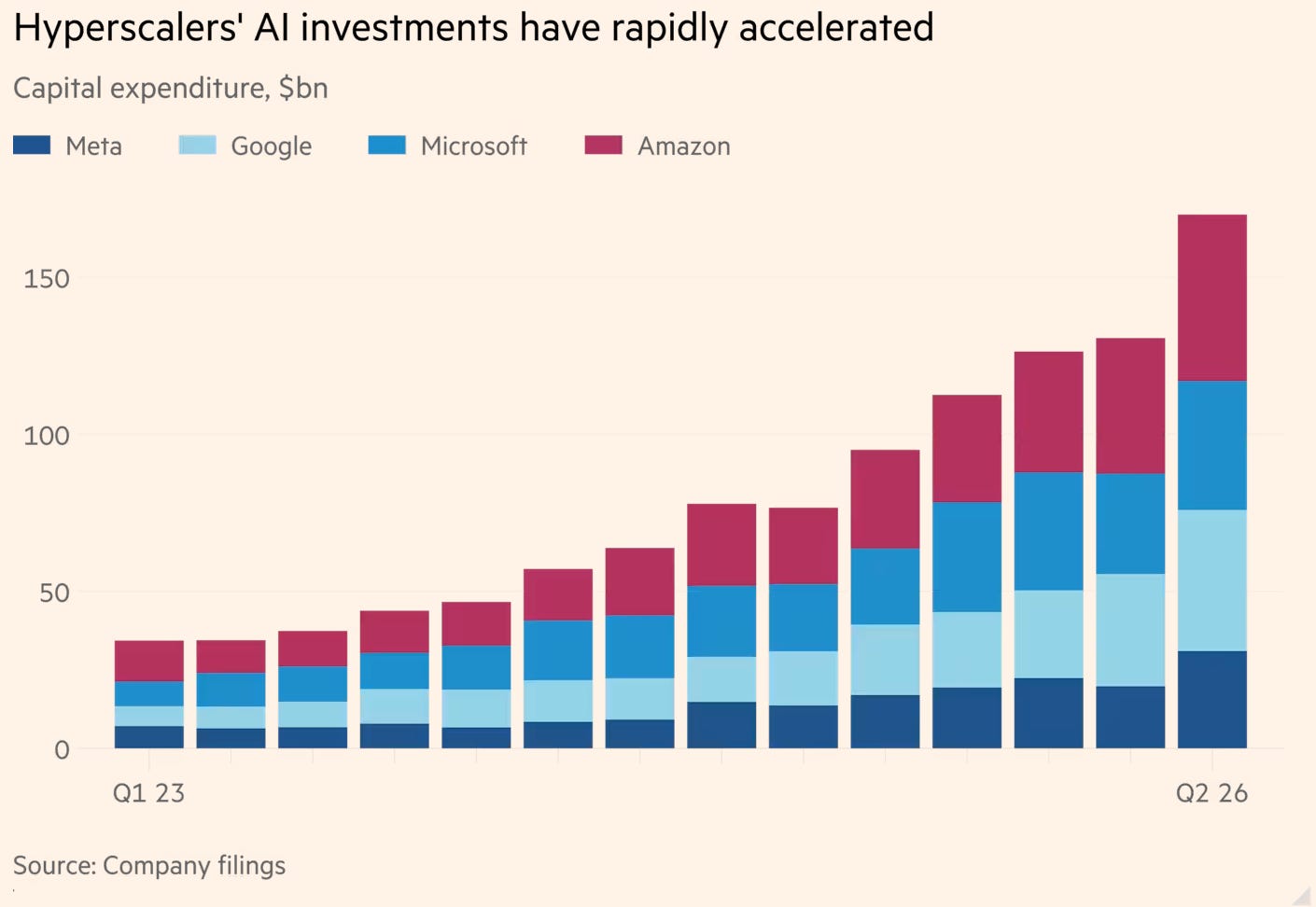
Source: Financial Times
Total AI investment for 2026 is projected at roughly $900bn - with $400bn funded by debt - before climbing to an estimated $1.4tn next year. Against this, combined hyperscaler revenues sit at just $150bn , illustrating the stark divergence undermining investor sentiment.
Reconciling revenue and spending is the only way to restore confidence. In the short term, focus must centre on boosting revenue by expanding both the ‘extensive margin’ (user growth) and the ‘intensive margin’ (deeper AI usage).
Whilst infrastructure demand may maintain current investment levels, spending value could fall as hardware transitions from specialised to commoditised, and improved efficiencies lower advancement costs. However, it will take time before this shift fully materialises to meaningfully reduce the gap.
AI is a long-term play, making the balance between spending and revenue difficult to achieve; but China shows it doesn’t have to be this way.
China’s Cost Advantage
In 2026, Chinese tech firms are forecast to invest less than a tenth of what their American counterparts spend on data centres.
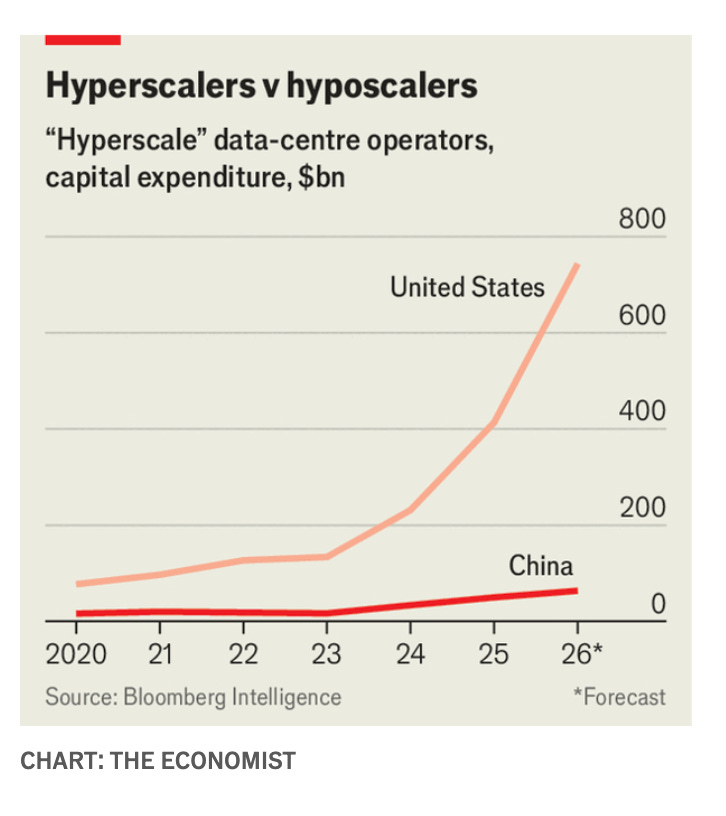
Source: The Economist
Lower capital expenditure is only part of the story. From land to equipment to labour - ranging from construction workers to AI specialists - operational inputs are significantly cheaper in China, yielding production costs that are marginal compared to the US.
Model distillation also plays a key role. China is often accused of training its models on the outputs of expensive American systems, allowing “Chinese AI developers (to) free ride on American spending” - another factor driving down costs. Meanwhile, US export controls have unwittingly helped by restricting the expensive inputs Chinese firms can buy. In response, Beijing regulators now actively discourage using second rate Nvidia chips, aiming to sanction-proof China’s AI infrastructure by pushing far cheaper, domestic alternatives.
Yet, lower costs do not mean AI is any less of a priority - if anything, state backing is emphasis is even more pronounced. The ‘Two Sessions’ conference outlined the 15th Five-year Plan (2026-30), re-emphasising China’s focus on technology and innovation. This push is underpinned by ambitious new targets: China aims to increase R&D spending by over 7% per year and plans to raise the digital economy’s share from 10.5% to roughly 12.5% of GDP by 2030, all whilst keeping labour productivity growth above overall GDP growth.
This final point is crucial: it highlights a top-down push for AI to drive real productivity gains. This ambition is evident in China’s focus on technology diffusion. Around Lunar New Year, a cluster of major models was deliberately released, leveraging the holiday to boost mass AI adoption and literacy. Consumer-aligned incentives - such as gamified ‘red packets’ and features embedded in everyday apps and telecom services - actively drive engagement. This strategy directly parallels Tencent’s 2014 WeChat campaign, which successfully normalised mobile payments and revolutionised China’s payment infrastructure.

Low production costs paired with domestic open-source models have made agentic technology available at a fraction of the price. This means effective AI integration is no longer a luxury reserved for top-tier firms, but a daily utility accessible to all. Combined with a population primed for adoption, this affordability and scale drive rapid growth at the extensive margin, paving a clear path toward commercialisation and revenue-spending reconciliation. This stands in stark contrast with American firms, where closing that gap remains far out of reach.
Competition at the frontier
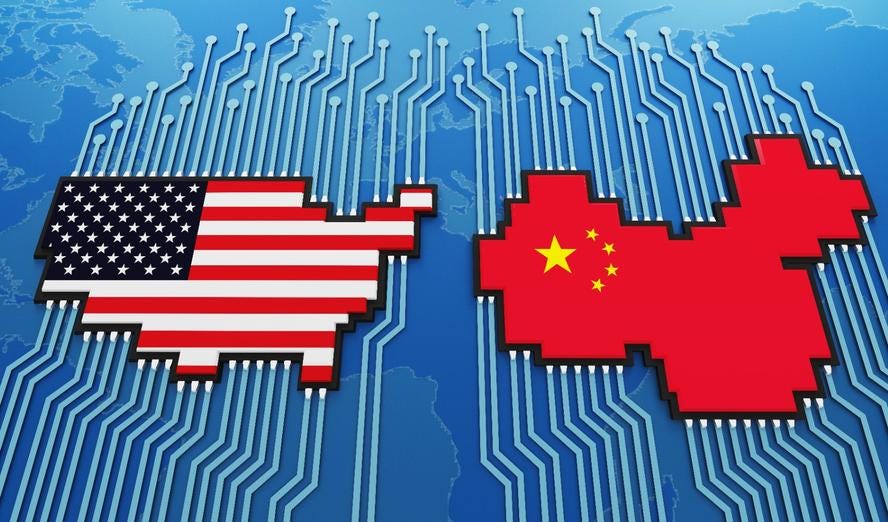
It is often heard that the US leads the frontier race, whilst China leads the adoption race. And, indeed, the Communist Party’s AI ambitions focus on diffusion “rather than creating ever cleverer systems that require ever more powerful semiconductors in ever more data centres.” This highlights the core divergence in strategy: Chinese firms concentrate their funding on maximising performance from less advanced inputs, while investing in techniques that reduce compute demand. Ultimately, China invests for efficiency, whilst the US invests for capacity.
The distinction between the “frontier race” and the “adoption race” suggests Chinese technology lags behind the US. Whilst this may have once been true; the gap is swiftly closing. Moonshot AI’s Kimi K3 matches top US models, whilst ByteDance’s Seedance 2.0 leads in video generation - outperforming both Open AI’s Sora 2 and Google’s Veo 3 across key metrics. Furthermore, China is pulling ahead in the “agent revolution” , fielding multiple agentic models that match or exceed their American counterparts.
Though America remains further along in the pursuit of Artificial General Intelligence (AGI) , this is largely because AGI is not Beijing’s primary focus. Ultimately, the rapid advancement of Chinese models demonstrates a nation can effectively compete at the frontier without needing to stretch to the absolute edge.
Conclusion
America’s AI push reveals a strategy focused on the intensive margin over the extensive one. But with spiralling infrastructure costs and struggling revenues, it is becoming increasingly clear that - from a commercial standpoint - this focus on capital intensity over broad accessibility may have been the wrong strategy to prioritise.
China’s strategy demonstrates why: pushing advancement past the point of diminishing returns yields little value compared to focusing on technology that can be scaled and commercialised. Technology built for practical impact will always generate more revenue than tech at the absolute frontier - no matter how incredible frontier models may be, if they aren’t useful to businesses and the broader public, their commercial potential remains limited.
The stark cost differential suggests that China is honing a comparative advantage in AI. Perhaps outsourcing development to the country would maximise global efficiency building and deploying the technology. But the geopolitical stakes mean that the US - and by extension the broader West - will never allow it.
Though AI regulation demands multilateral cooperation, the technology is increasingly splitting into two parallel dimensions - developed, deployed, and dominated by opposite sides of the globe. Far from signalling the end of the AI race, this bifurcation ensures its continuation as geopolitical tensions intensify.
If the American hyperscalers fail to address their structural strategy and spending issues quickly, global capital, sentiment and power may all begin to diffuse eastward.
Washington certainly doesn’t want that to happen.
By Ananyaa Gupta